
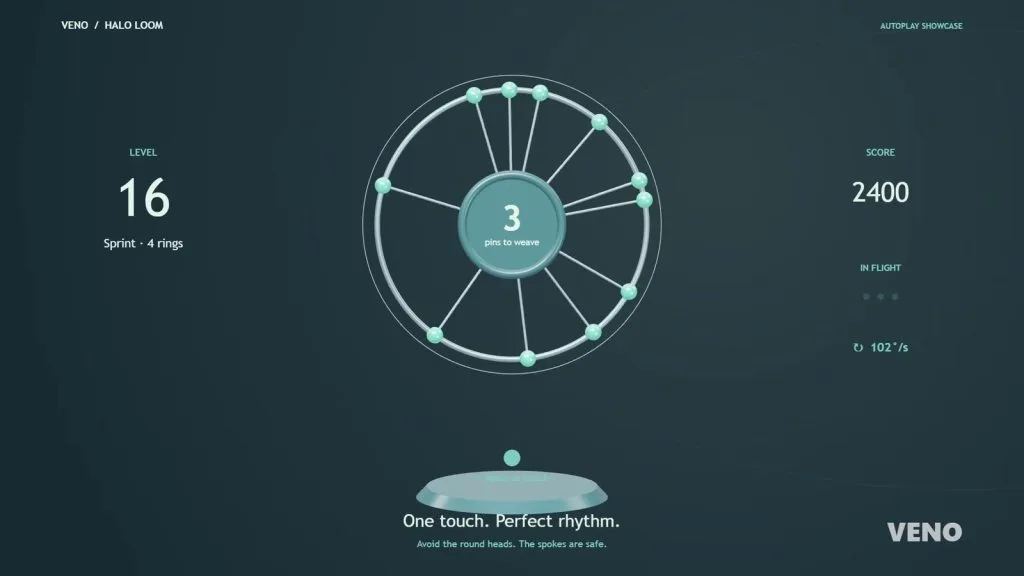
The aa game is a one-touch timing puzzle: a circle spins in the middle of the screen and you tap to shoot pins into it, one by one, without letting any pin touch another. Every pin you land stays stuck to the circle and turns with it, so each new shot has less room than the last. Place all your pins safely and the level is cleared; hit a pin and you start that level again.
| Quick facts | |
|---|---|
| Core action | Tap once to launch a pin into a spinning circle |
| How you lose | Your new pin touches a pin that is already there |
| Famous ancestor | aa, a minimalist mobile game that went viral in 2014 |
| Controls | One tap, one click or one key |
| Typical level | 10 to 40 seconds |
| Main skills | Timing, patience, reading rotation speed |
▶ Watch a full Sprint run in our gameplay video: VENO Halo Loom on YouTube
Where the aa game came from
In 2014 a tiny black-and-white game simply called aa spread through phones and school corridors. It had no characters, no story and almost no colour: just a dark circle, a number of pins waiting at the bottom and a single rule. Players compared it to Flappy Bird, the other one-tap hit of that year, because it was easy to learn, hard to master and very quick to restart.
The idea was so clean that it became a genre of its own. Search any app store for “pin circle”, “pin the ball” or “aa game” and you will find many variations. Most keep the same core and add a twist: circles that change direction, rotation that speeds up and slows down, pins already placed before you start, or time limits.
How a pin-circle game works
The rules fit in four lines:
- A circle rotates at the centre, sometimes with a few pins already attached.
- You have a fixed number of pins to place. A counter tells you how many are left.
- Each tap fires one pin straight up into the circle, where it sticks and starts to rotate.
- If the round head of your new pin touches another pin, the level fails. Place them all and the level is complete.
The tension comes from geometry. With three pins on the ring, there is room everywhere. With twenty, the gaps between pin heads are only a little wider than one head, and they pass the launch point in a fraction of a second.
How VENO Halo Loom builds on the classic
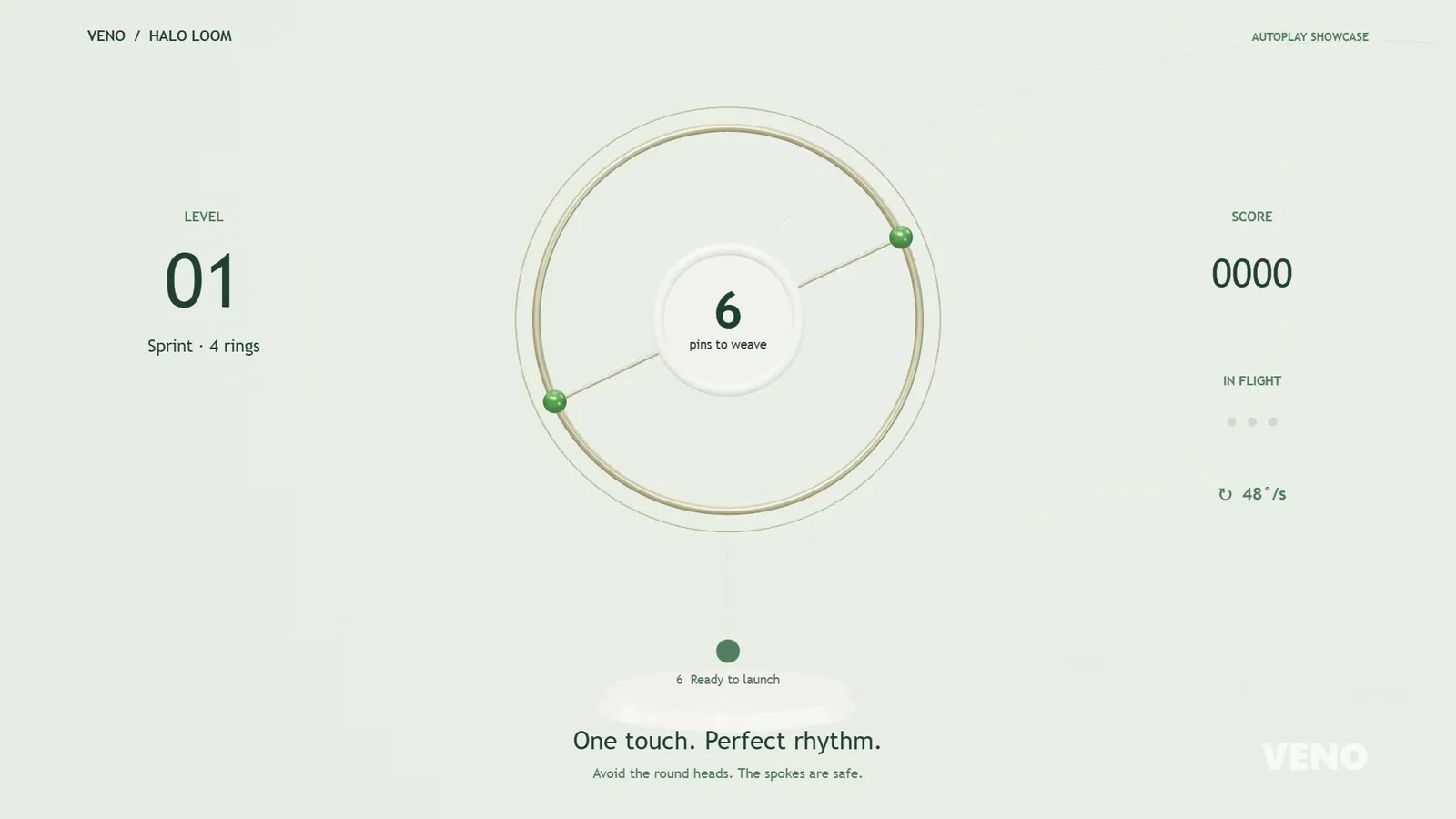
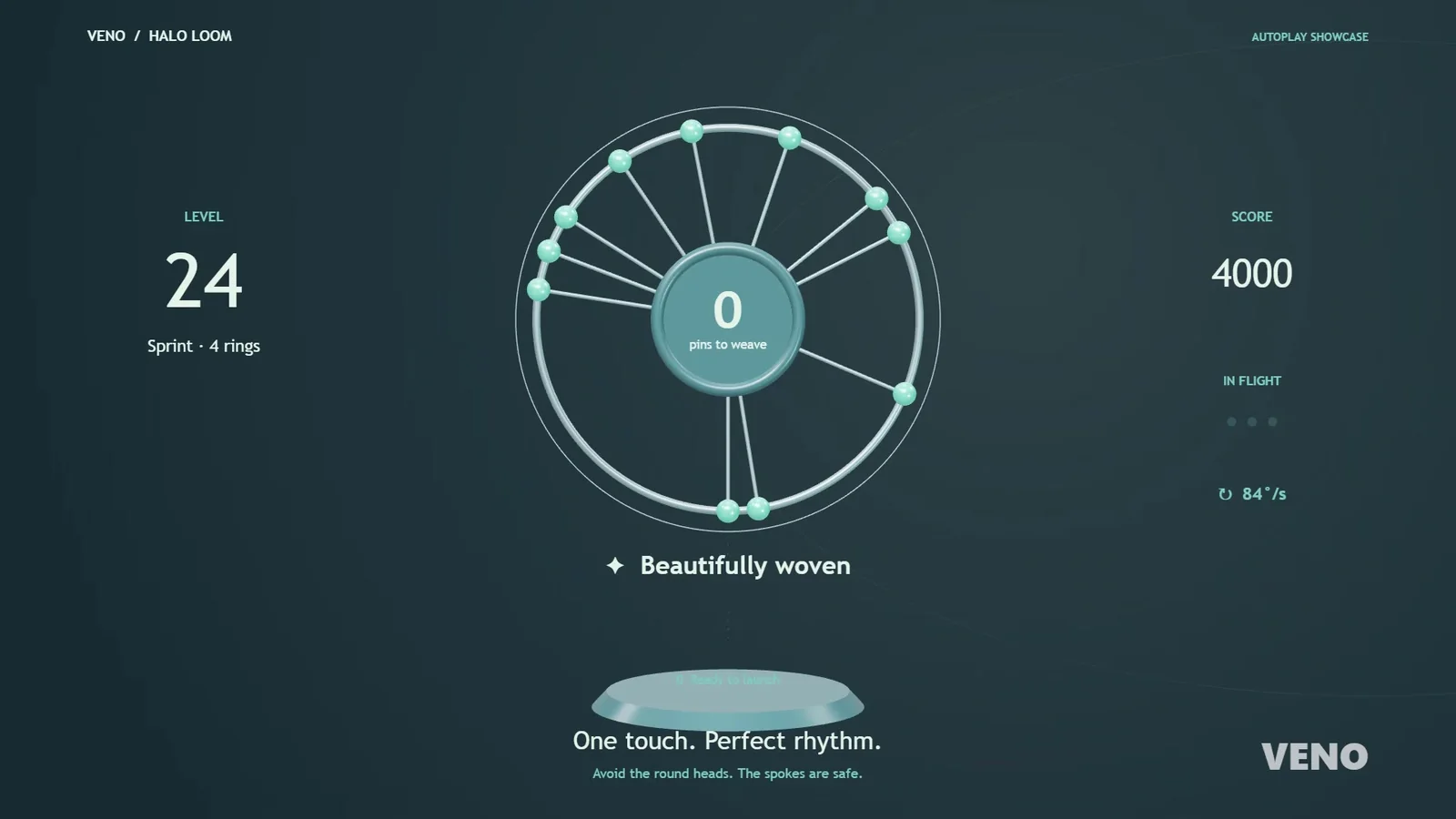
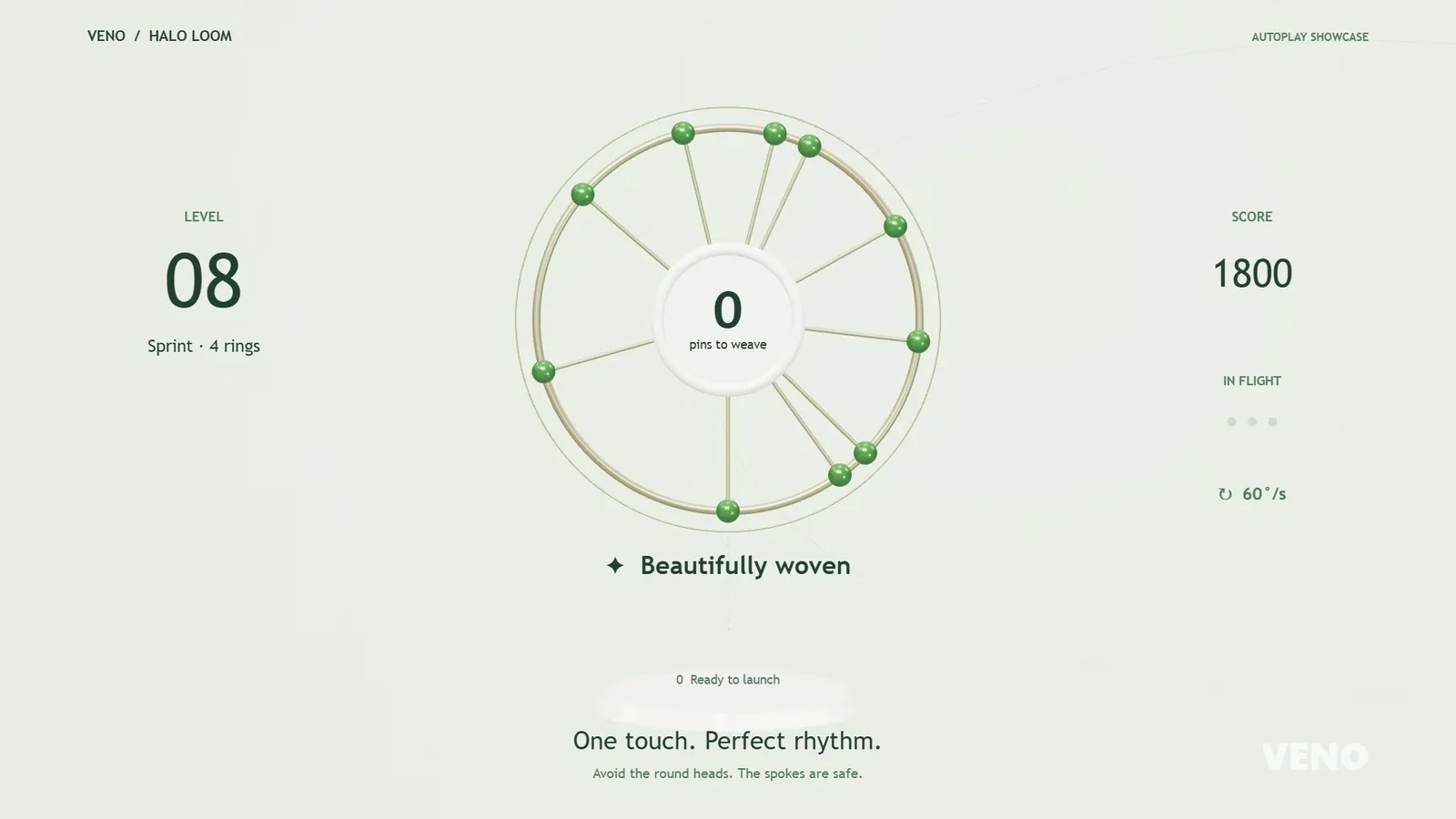
VENO Halo Loom keeps the pure one-touch rule and wraps it in a calmer, more decorative look. Each pin you land is linked to the centre by a thin spoke, so a finished ring looks like woven light rather than a pincushion. The number in the middle shows how many pins are still to weave.
A few details change how you play:
- The spokes are safe. Only the round heads are dangerous, so you can aim straight across a spoke.
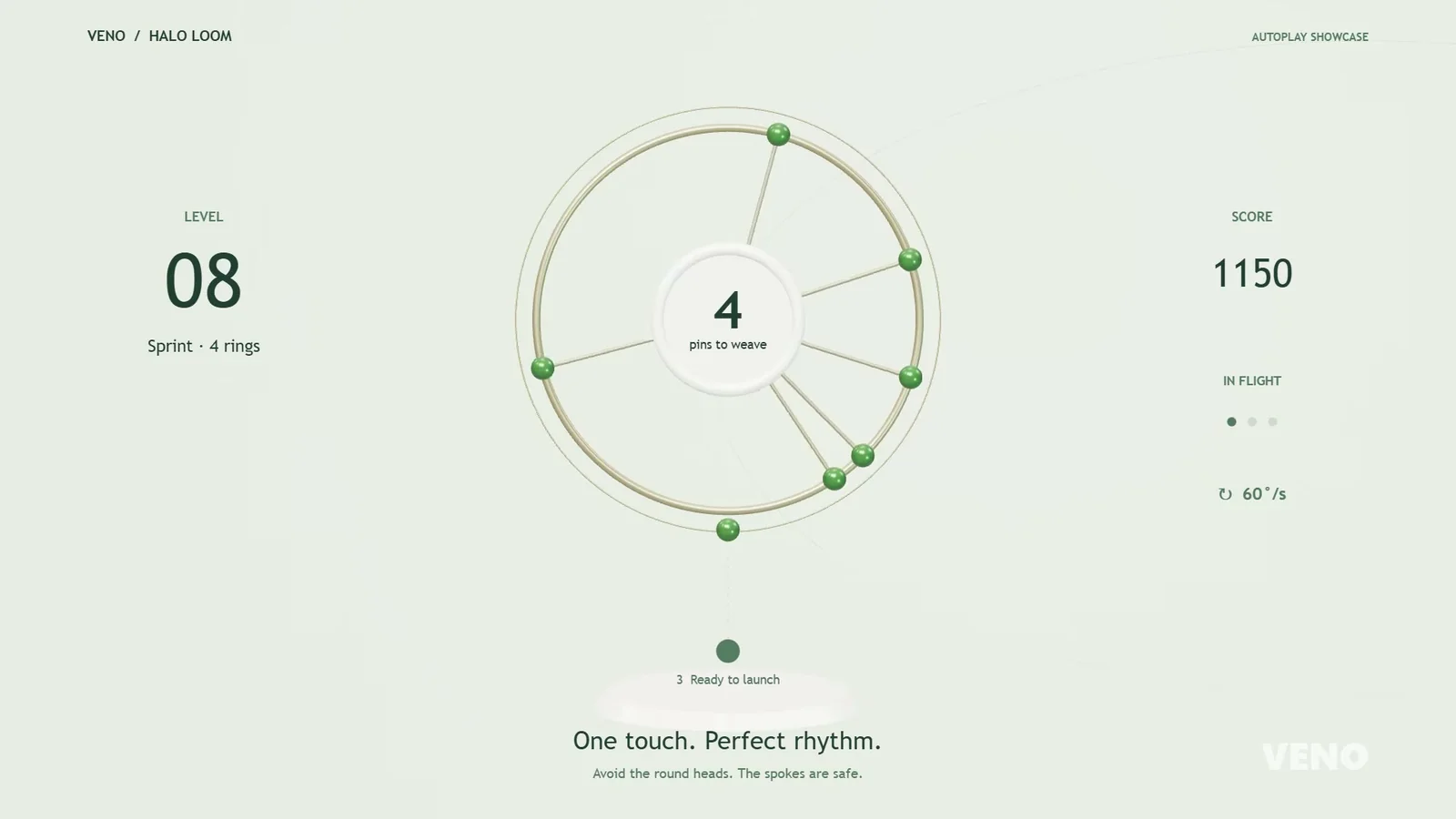
- Up to three pins can fly at once. Quick taps are allowed, but you must also watch the pins that are still travelling.
- Later rings spin faster and gaps shrink as the ring fills, exactly the moment where patience pays off.
The game also offers six ways to play, which makes it easy to practise one skill at a time:
| Mode | What it trains |
|---|---|
| Classic | Ring-by-ring progress at your own pace |
| Sprint · 4 rings | Keeping focus across four rings in one run |
| Endless | Consistency: how long can you go without a mistake |
| 60-second rush | Speed under a clock |
| Daily challenge | Three new rings every UTC day |
| Practice | Learning the rhythm with no pressure |
9 tips to clear tight rings
These tips work for any pin-circle game, and they are especially useful in Halo Loom’s faster rings.
- Pick one launch moment. Watch the gap you want, not the whole ring. Tap when the middle of that gap reaches the launch line.
- Fill wide gaps first. Early on, place pins halfway between existing heads. Evenly spread pins leave even gaps later.
- Count rhythm, not angle. On a steady spin, the same gap returns at a regular beat. Tap on the beat.
- Don’t chain taps on a crowded ring. Three pins in flight are tempting, but on a nearly full ring one at a time is safer.
- Use the spokes. In Halo Loom only heads collide, so ignore the lines and judge only the circles at the rim.
- Breathe before the last three pins. Most failures happen at the very end. Wait one full turn if you need to.
- Learn speed changes in Practice. When a ring speeds up, your timing must move earlier. Practice mode lets you feel that safely.
- Play Daily for variety. New rings each day stop you from relying on memory alone.
- Restart fast, stay calm. A miss costs only seconds. Treat it as information about timing, not as a loss.
Why one-touch timing games are so satisfying
Pin-circle games give a clear loop: watch, wait, tap, see the result instantly. There are no menus to manage and nothing to collect except progress, so all of your attention goes to one decision. That makes them a good fit for short breaks, a few minutes on the bus, or a reset between tasks.
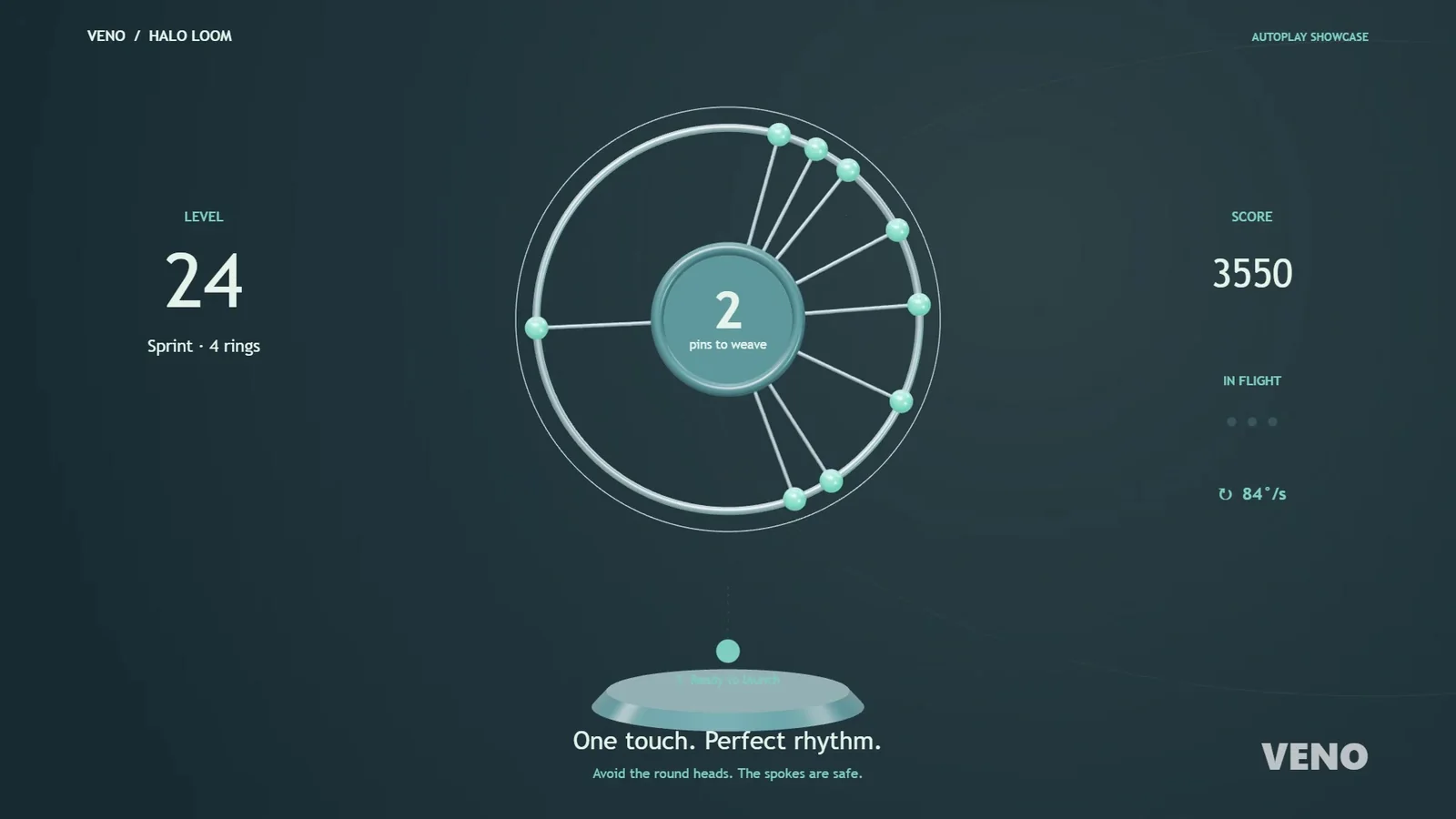
Halo Loom adds a reward for finishing: every completed ring is saved to your collection as a small piece of woven light, and you can unlock new ateliers that change the look of the rings. A light ivory theme, a dark teal theme, soft sounds and a reduced-motion option keep the experience easy on the eyes.
Play it now
Ready to test your timing? VENO Halo Loom runs free in your browser on phone and desktop, in landscape or portrait, with touch, mouse or keyboard, and nothing to install.
FAQ
What is the aa game?
It is a one-touch timing game where you shoot pins into a spinning circle without letting them touch each other. The original aa became a viral mobile hit in 2014 and inspired many “pin circle” games.
Is the aa game hard?
The first levels are easy, but difficulty rises quickly as the circle fills and spins faster. Most players find it relaxing at first and very tense in the last few pins.
Can I play an aa-style game in my browser?
Yes. VENO Halo Loom is a free browser game in the same style, with six modes and no download.
What happens if two pins touch?
In a classic aa game the level fails and you try again. In Halo Loom only the round heads collide; the thin spokes are safe.
How do I get better at pin-circle games?
Focus on one gap at a time, spread early pins evenly and tap on a steady rhythm. Practising on slower rings first helps a lot.