
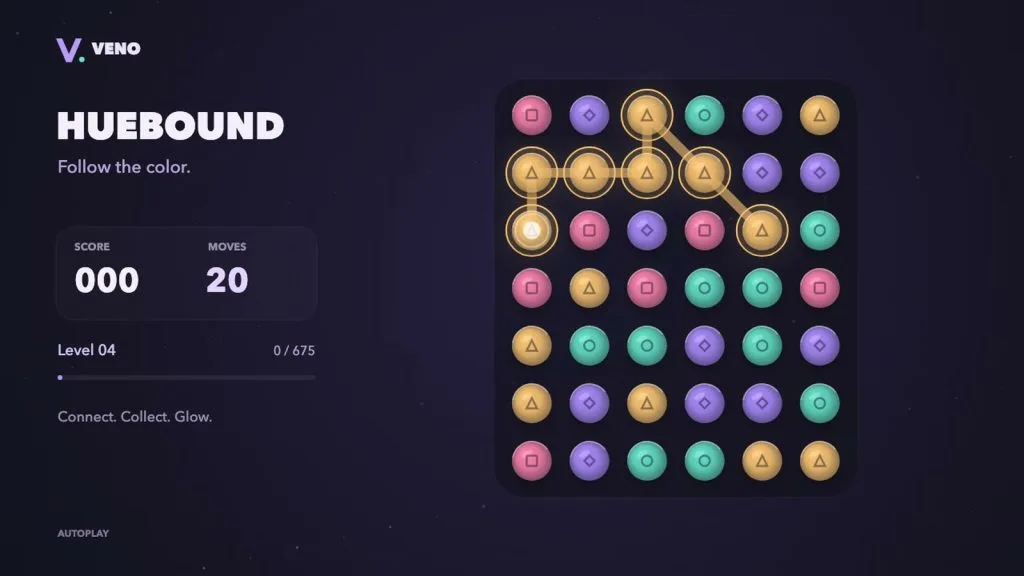
A color link puzzle is a game where you drag one continuous line through touching pieces of the same color, then release to clear them all at once. Unlike swap-based match-3 games, you choose how long the chain is, and in most link puzzles a longer chain is worth far more than the same number of gems cleared in short pieces.
This guide explains how chain scoring works with real numbers, where the genre came from, and how to plan bigger chains, using gameplay from VENO Huebound as the example.
Quick facts
| Item | Color link puzzle |
|---|---|
| Core move | Drag across neighboring pieces of one color, release to clear |
| Minimum chain | Usually 3 pieces |
| Directions | Up, down, left, right; many games also allow diagonals |
| Key to high scores | Longer chains earn a growing bonus |
| Typical limit | A move counter, not a timer |
| Best for | Short, calm sessions on phone or desktop |
What makes a link puzzle different from match-3
In a classic match-3 you swap two neighbors and hope a line of three forms. In a link puzzle nothing moves until you decide: you trace your own path, so you see the whole result before you commit.
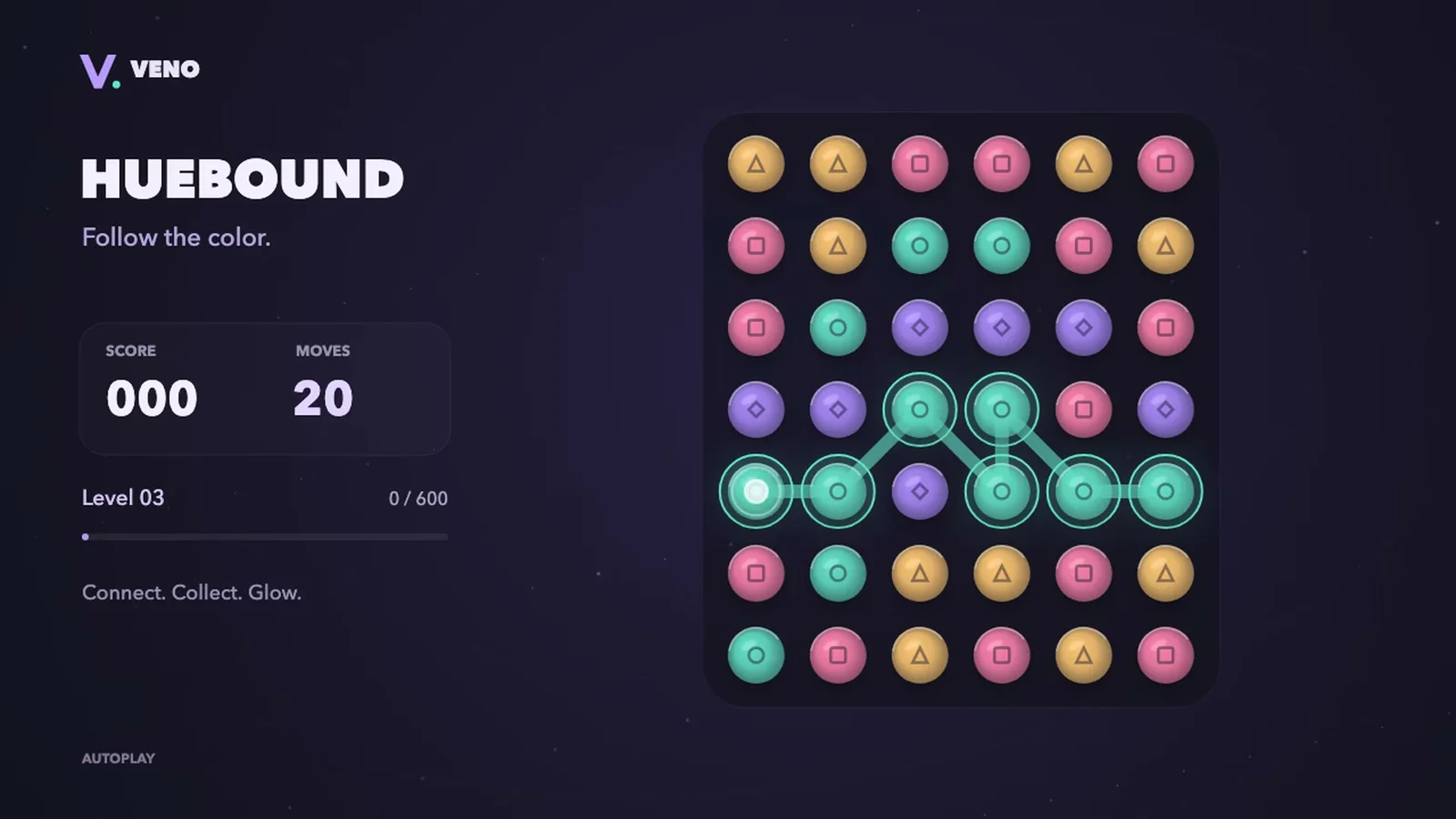
That changes how you think. Instead of hunting for one lucky swap, you read the board for clusters: where do gems of one color touch each other, and how could one line pass through all of them? When the chain clears, the gems above fall into place and new ones drop in, which sets up (or breaks) the next chain.
How chain scoring works
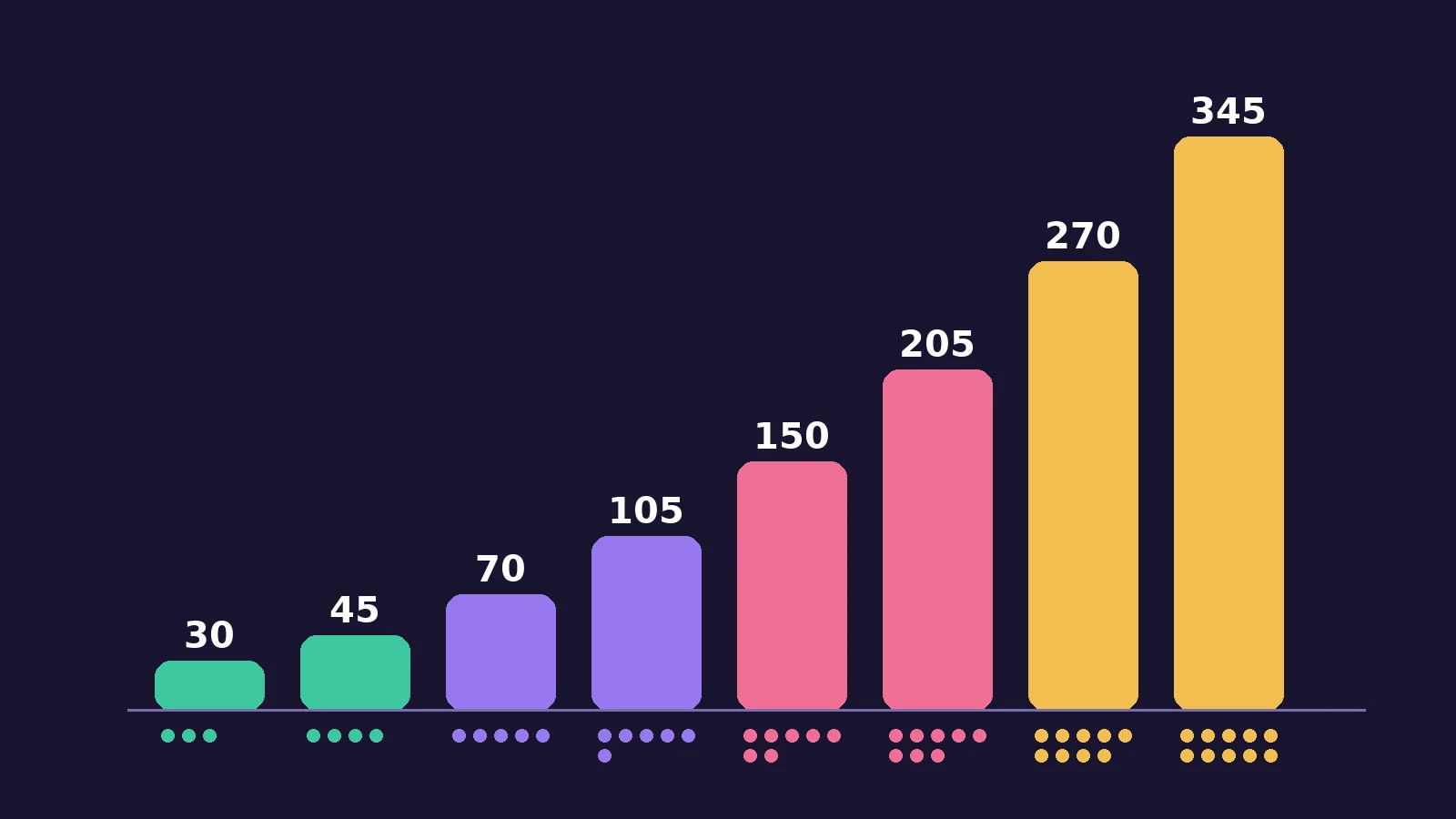
Most link puzzles pay a base value per piece plus a bonus that grows with length. In VENO Huebound each gem in a chain scores 10 points, and the bonus on top grows with the square of the extra length. In practice:
| Chain length | Points | Points per gem |
|---|---|---|
| 3 | 30 | 10 |
| 4 | 45 | 11 |
| 5 | 70 | 14 |
| 6 | 105 | 17.5 |
| 7 | 150 | 21 |
| 8 | 205 | 26 |
| 9 | 270 | 30 |
| 10 | 345 | 34.5 |
Look at the last column. A 10-gem chain earns 345 points, while the same ten gems cleared as short chains earn roughly 100. Put another way, one 10-gem chain is worth more than eleven separate 3-gem chains, and it uses one move instead of eleven.
Why the move limit makes this matter
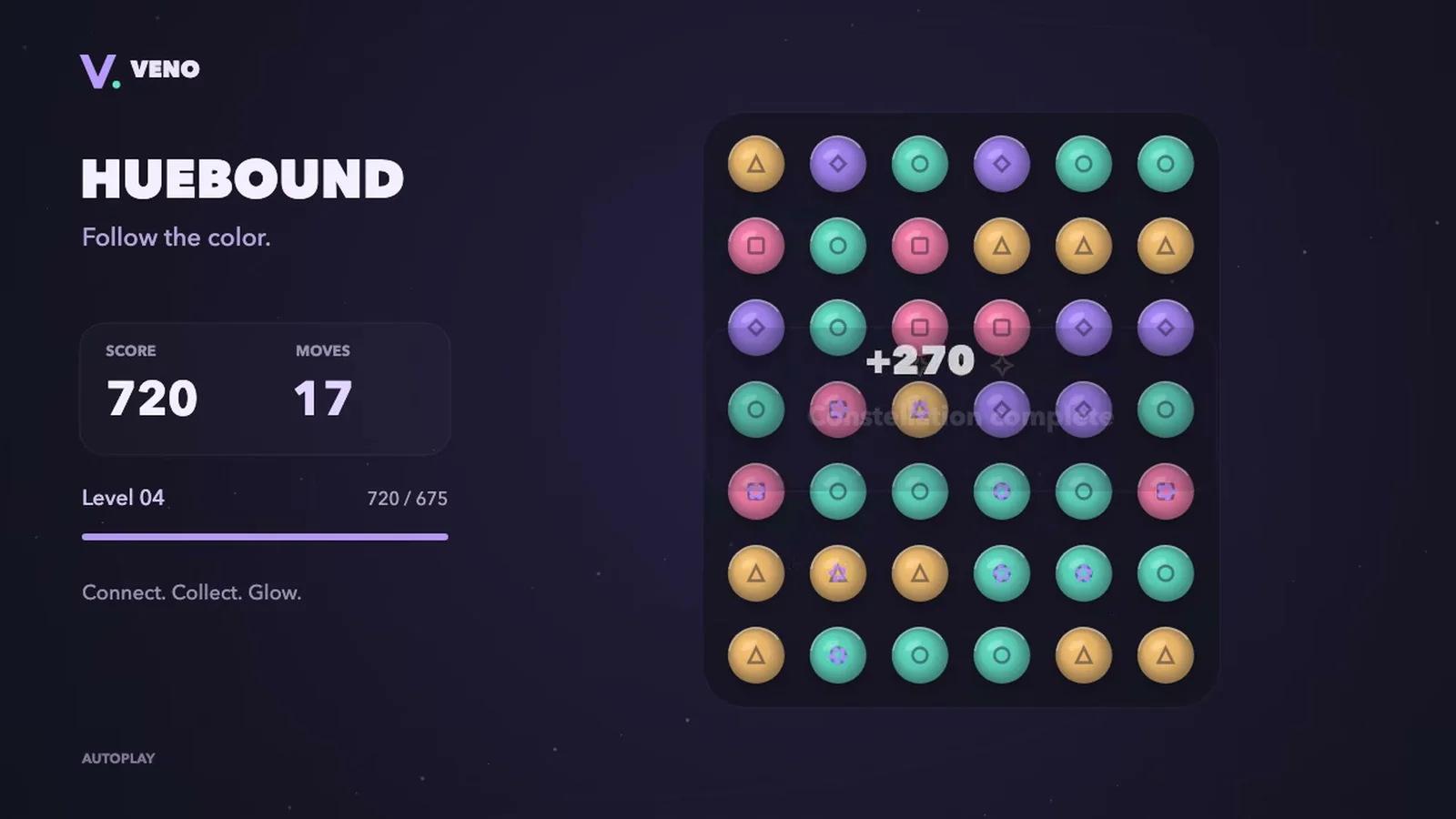
Huebound gives you 20 moves per level and a target score that rises with every one of its 30 constellations: 450 on level 1, then 75 more each level. That turns the table above into a simple plan:
| Level | Target | Points needed per move | Chain that covers it |
|---|---|---|---|
| 1 | 450 | 22.5 | 3 gems |
| 10 | 1,125 | about 56 | 5 gems |
| 20 | 1,875 | about 94 | 6 gems |
| 30 | 2,625 | about 131 | 6–7 gems |
Early boards forgive short chains. Later boards only open up if most of your moves are chains of six or more, or if you mix a few very long chains with quick ones.
A short history of the genre
Link puzzles grew up with touchscreens, because dragging a finger through pieces feels natural.
- Dots (2013). Betaworks released this minimalist iPhone game in spring 2013. You connected same-colored dots horizontally and vertically, and closing a square cleared every dot of that color. It passed a million downloads in its first week.
- Jelly Splash (2013). Wooga’s mobile hit took the drag-to-link idea into a long, level-based adventure with goals and obstacles.
- Two Dots (2014). The sequel to Dots added a map of levels, goals and obstacles while keeping the calm look.
- LINE: Disney Tsum Tsum (2014). Launched in Japan, it had players chain touching plush characters of the same kind, and it became one of the best-known chain puzzles in Asia.
Modern browser games like Huebound keep the core rule and drop the pressure: no timer, a fixed number of moves, and help buttons when you are stuck.
8 tips for longer chains
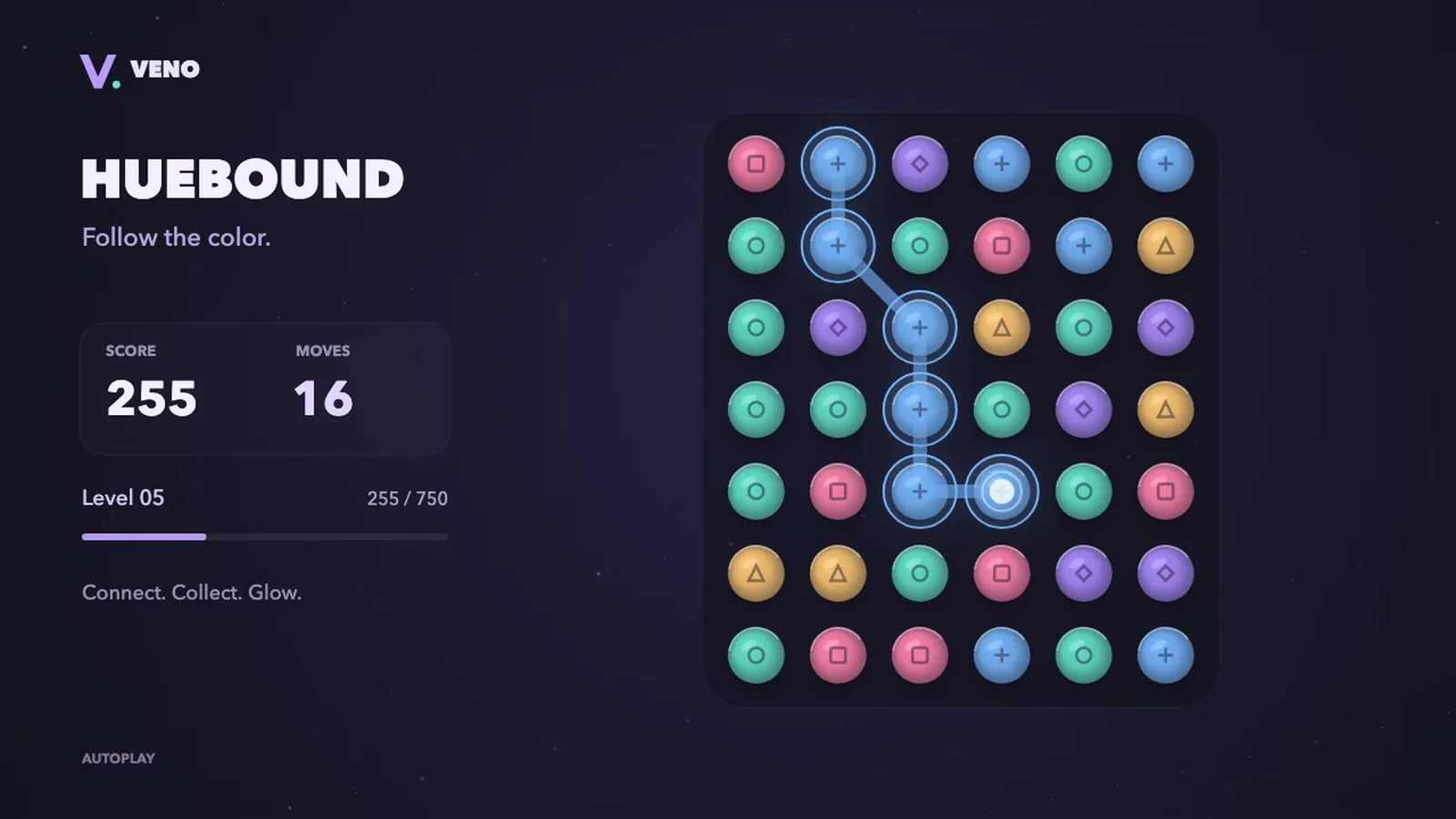
- Count before you drag. Trace the path with your eyes first and count the gems. If it is under five, look once more for a longer route.
- Use diagonals to snake. When diagonals are allowed, a zig-zag path through a cluster often collects two or three more gems than straight lines.
- Pick the color with the most gems. The color that covers most of the board is usually where the longest chain hides.
- Clear one color to merge another. Sometimes a short chain is worth it because it drops two groups of another color together. Think one move ahead.
- Save short chains for the end. When the target is almost reached, any chain finishes the level. Earlier, a 3-gem chain wastes a move.
- Read the symbols as well as the colors. Each Huebound gem carries its own shape (triangle, circle, square, diamond), which helps you spot a path quickly, especially once the fifth color joins at level 5.
- Use the help buttons wisely. Hint shows a connection, Undo takes back your last move, and Shuffle mixes the board when nothing good is left. Keep Shuffle for real dead ends.
- Do the target math. Divide the points still needed by the moves left. If the answer is above 100, you need chains of six or more from now on.
Play it now
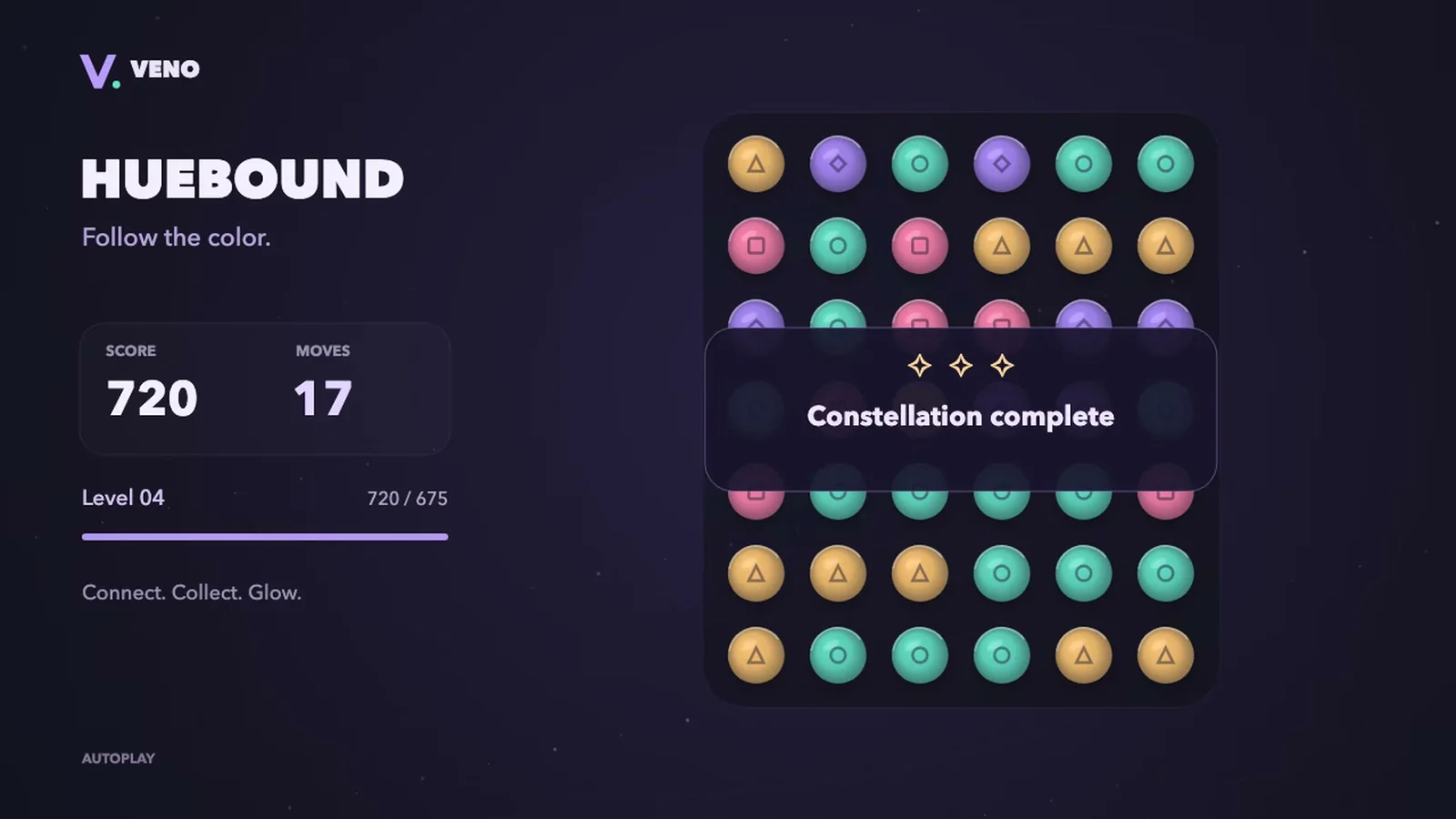
The quickest way to feel the difference between short and long chains is to try it. VENO Huebound is a free color link puzzle that runs in your browser on phone or desktop, with 30 constellations, no timer and progress saved automatically. Connect 3 or more glowing gems of the same color, diagonals included, and chase that 10-gem chain.
FAQ
What is a color link puzzle game?
It is a puzzle where you drag one line through touching pieces of the same color and release to clear them. Longer chains usually earn bonus points.
Is a color link puzzle the same as match-3?
No. Match-3 games are played by swapping two neighbors. In a link puzzle you draw the whole chain yourself and decide its length before anything clears.
How many gems do I need to connect?
Most link puzzles need at least three. In Huebound you connect 3 or more gems of the same color, and diagonal neighbors count.
Why should I make long chains instead of many short ones?
Because the bonus grows with length. A 10-gem chain scores 345 points in Huebound, more than eleven 3-gem chains, and it uses a single move.
Is there a free color link puzzle I can play in the browser?
Yes. VENO Huebound is free, needs no install, and works with touch, mouse or keyboard in ten languages.