
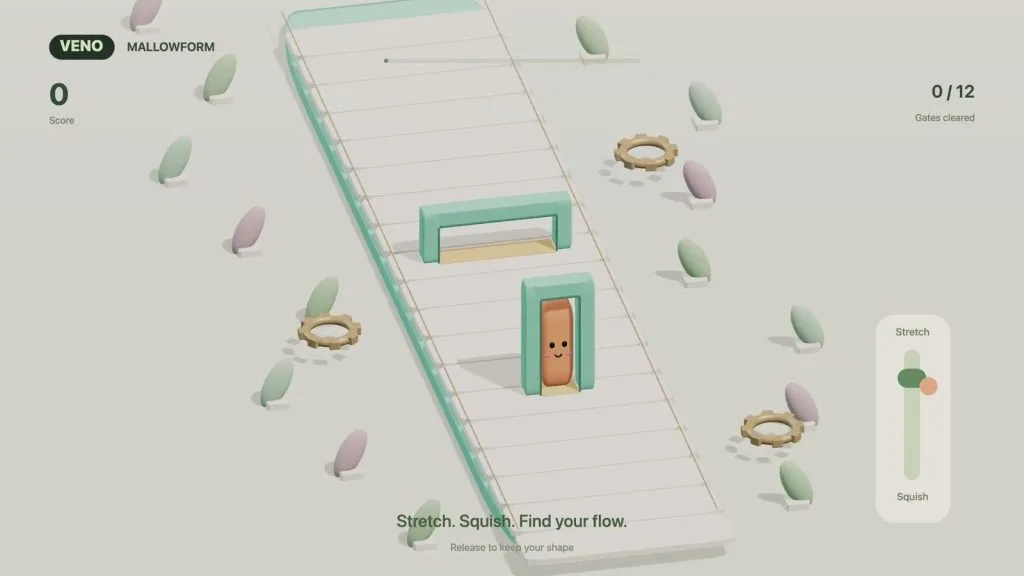
A hole in the wall game is a game where a wall with a cut-out shape moves toward you, and you have to change your shape to fit through the gap before it arrives. Get the shape right and you pass; get it wrong and the wall knocks you out. The idea began as a Japanese TV game, and today it lives on as quick shape-fitting runners you can play on a phone or in a browser.
| Quick facts | |
|---|---|
| Genre | Shape-fitting runner / “hole in the wall” puzzle |
| Core rule | Match the opening in the wall before it reaches you |
| Origin | Nōkabe (“Brain Wall”), a segment of the Japanese TV show The Tunnels’ Thanks to Everyone, started in 2006 |
| What makes it hard | Timing: you have to read the next gap early |
| Skills it uses | Spatial reasoning, planning one step ahead, calm timing |
| Play free in a browser | VENO Mallowform (stretch or squish a jelly block, no install) |
▶️ Watch the gameplay: VENO Mallowform on YouTube · Shorts
What is a hole in the wall game?
Every game in this family has the same three parts:
- A wall with an opening in a particular shape.
- A player who can change shape, pose or size.
- A clock, usually the wall moving closer, that forces you to decide before you are ready.
There is no enemy to defeat and no maze to solve. The only question is “does my shape fit the hole?”, asked again and again, faster and with stranger shapes each time. That is why the idea is so easy to understand at a glance and still hard to master.
From a Japanese TV wall to phone and browser games
The format comes from Japan. Nōkabe (脳カベ, “Brain Wall”) was a segment of the Fuji TV variety show The Tunnels’ Thanks to Everyone. Contestants in shiny unitards stood in front of a pool while a big Styrofoam wall with a cut-out slid toward them along a track. Anyone who could not twist into the shape in time was pushed into the water behind them.
According to The Japan Times, the show started in 2006 and was later sold to more than 40 countries under the name Hole in the Wall. In the United States it ran on Fox from 2008 to 2009 and then returned on Cartoon Network from 2010 to 2012.
When the idea moved to games, the human body was replaced by something easier to control: a block, a blob or a figure that you stretch, squash or pose with one finger. The wall stays the same: it keeps coming, and it does not care how close you were.
| TV show (Hole in the Wall) | Shape runner (VENO Mallowform) | |
|---|---|---|
| What changes shape | A person’s whole body | A soft jelly block |
| How you change it | Twist, crouch, stretch | Drag up to stretch, down to squish |
| What moves | The wall moves toward you | You glide forward through the gates |
| Failing | Knocked into a pool | The block stops and shows if it was too tall or too wide |
| Retry | Next contestant | Instant Retry |
How VENO Mallowform plays the idea
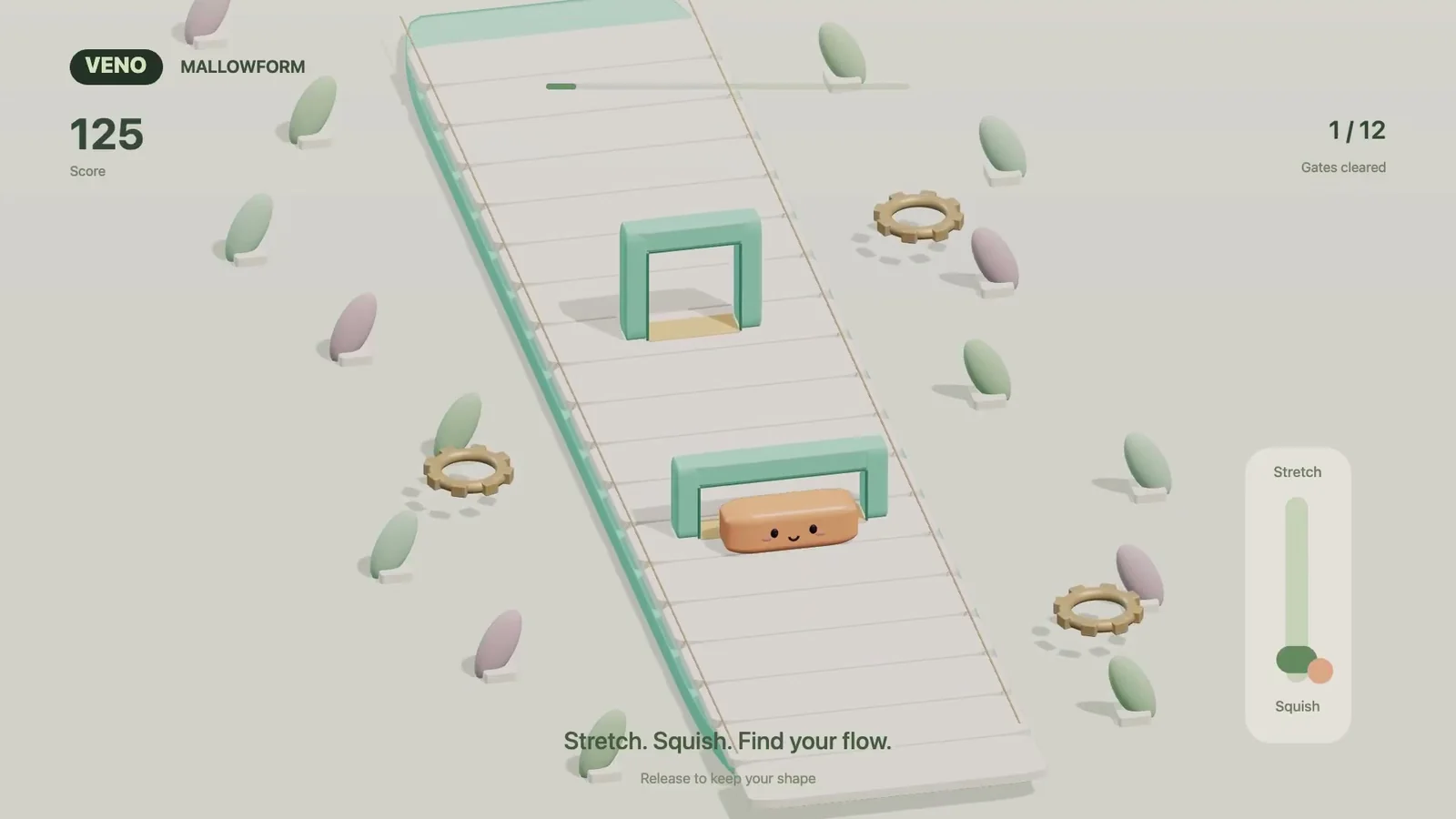
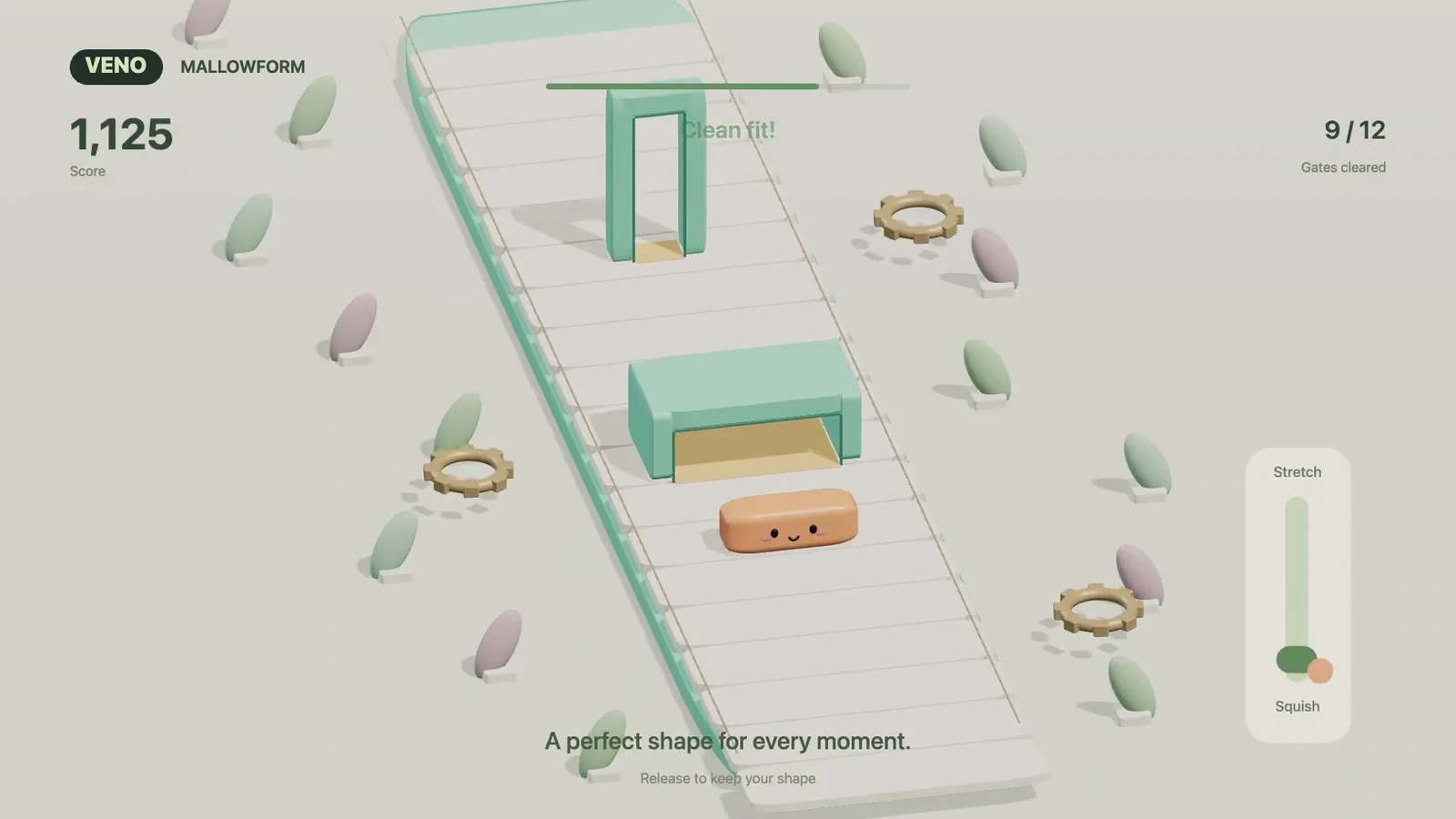
VENO Mallowform turns the moving wall into a calm 3D runner. A peach jelly block glides along a ceramic conveyor lined with mint gates. You never steer left or right, and you never stop. The only thing you control is the block’s shape.
- Drag up to stretch the block taller and narrower.
- Drag down to squish it shorter and wider. You can also use the on-screen Stretch–Squish slider or the Up and Down keys.
- Let go and the block keeps the shape you chose instead of snapping back to a cube.
- Read the next gate and start changing shape before you reach it.
- Clear the gate once the back of the block has passed through it.
The height-for-width rule: why fitting is harder than it looks
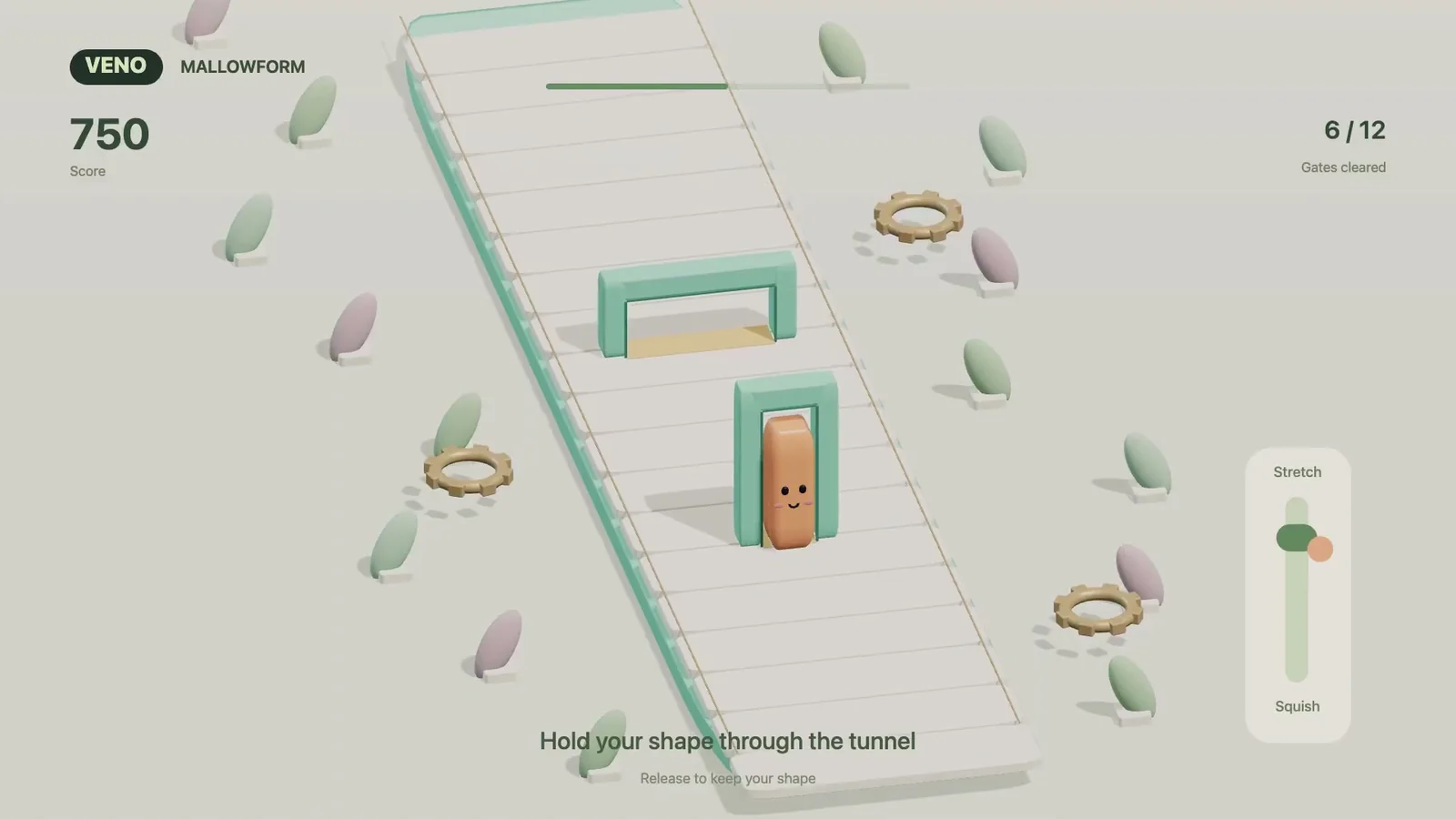
In the TV show you could crouch and spread your arms at the same time. Mallowform does not let you cheat like that. The block’s cross-section always keeps the same size, so every bit of height costs width, and every bit of width costs height. There is no shape that is both short and thin.
Changing shape also takes time: about two-thirds of a second to go from the flattest pose to the tallest. That small delay is the real challenge. If you only react when the gate is right in front of you, you will still be changing shape when you hit it.
The gates come in a few clear types:
| Gate type | Shape it wants | What to watch for |
|---|---|---|
| Tall slot | Stretched tall and thin | Start stretching early |
| Low arch | Squished flat and wide | Don’t over-squish if the gap is narrow too |
| Square frame | Somewhere in the middle | Close to the starting cube |
| Long tunnel | One shape held all the way | Don’t move until your tail is out |
| Paired frames | Two different shapes back to back | Plan the switch between them |
Score, Clean fits and the perfect 1,500
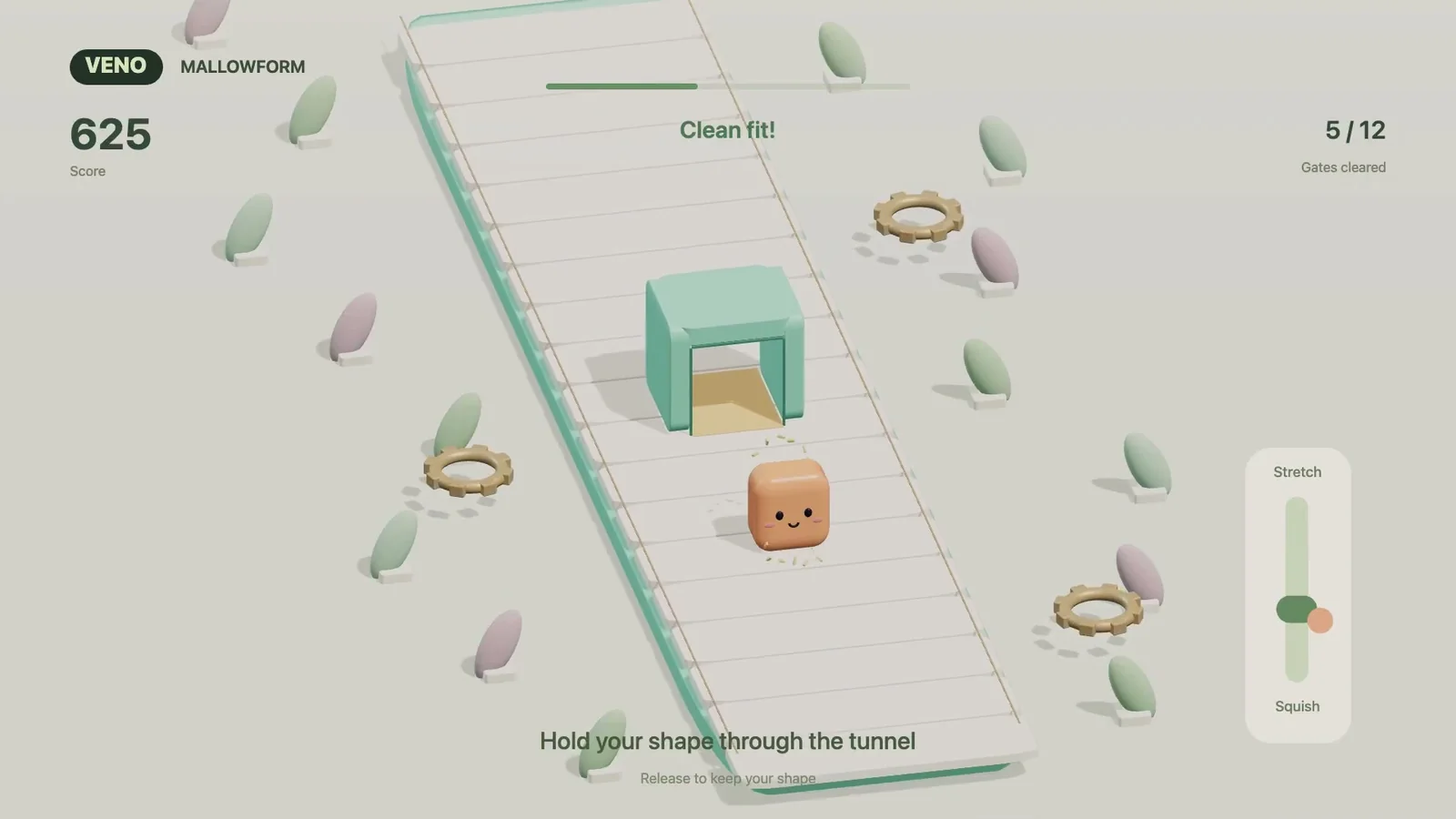
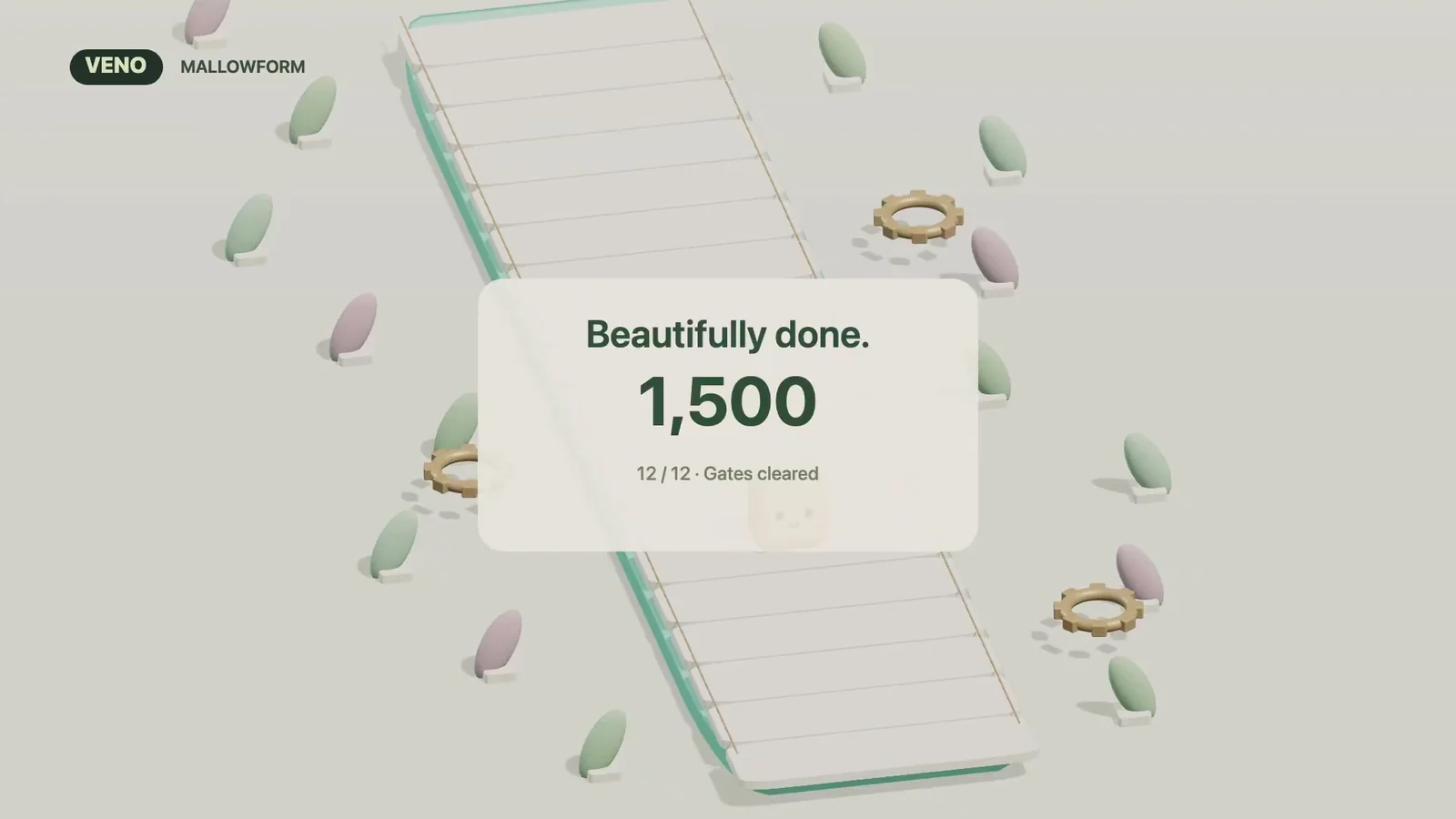
Every gate you clear is worth 100 points. If you stay comfortably in the middle of the gap the whole way through, you also earn a Clean fit worth 25 more. A run of twelve gates, all of them Clean, adds up to 12 × 125 = 1,500 points, exactly the perfect run shown in the video.
Hit a gate and the block stops in the pose that failed and shows whether you were too tall or too wide. That feedback is the best teacher in the game: you know exactly which way to adjust on the next try. Unlockable looks change only colour, pattern, eyes and trail, never the shape, the speed or the size of the gates, so everyone plays the same test.
8 tips to fit through every gate
- Look two gates ahead. The gate in front of you is already decided; your real job is the next one.
- Start early, move once. One smooth drag at the right time beats several small corrections.
- Aim for the middle, not the edge. A shape that barely fits still passes, but the middle earns the Clean fit bonus.
- Hold still in tunnels. A gate counts only when the back of the block is out, so keep the shape until the tail clears.
- Use the default cube as a reset. Square frames are close to the starting shape, so they are a good moment to breathe.
- Plan paired frames as one move. When two frames sit back to back, think of the second shape before you enter the first.
- Learn from the failure pose. “Too tall” means squish a bit more next time; “too wide” means stretch.
- Pick the control you like. Drag works best on phones; the slider or the Up and Down keys can feel more precise on a desktop.
Who hole in the wall games are good for
- Short breaks: one run takes under a minute and needs one finger or two keys.
- Kids and families: the rule “make your shape match the hole” needs no reading, and the jelly block is friendly and soft.
- Puzzle fans: the height-for-width trade turns a reflex game into a small spatial puzzle.
- Anyone who wants a calm game: there are no enemies to fight, just you, a soft block and the next gate.
Play it now
Want to try a hole in the wall game without installing anything? VENO Mallowform runs free in your browser on phone and desktop, in ten languages. Stretch, squish, read the next gate early and go for a perfect run of Clean fits.
FAQ
What is a hole in the wall game?
It is a game where a wall with a shaped opening comes toward you and you must change your shape to fit through it in time. It started as a Japanese TV game and now exists as quick shape-fitting games.
Where did Hole in the Wall come from?
It comes from Nōkabe, or “Brain Wall”, a segment of the Japanese Fuji TV variety show The Tunnels’ Thanks to Everyone that started in 2006. The format was later sold to more than 40 countries.
How do you get a Clean fit in VENO Mallowform?
Stay comfortably in the middle of the gap for the whole gate. Each Clean fit adds 25 points on top of the 100 points for clearing the gate.
Why can’t the block be short and thin at the same time?
The block’s cross-section always stays the same size, so gaining height costs width and gaining width costs height. Picking the right balance is the whole puzzle.
Can I play VENO Mallowform on my phone?
Yes. VENO Mallowform is made for portrait phone screens with a big drag area, and it also plays on a desktop with a mouse or keyboard, with nothing to install.