
Sorting games give you a messy pile of things and one simple job: put each thing where it belongs. Balls go into the tube of the same colour, water is poured until every glass holds one colour, toys go into the box with the matching picture. There is no fast reflex test and no story to follow – just a jumble that slowly turns into order. That small change from chaos to calm is exactly why so many people play them to relax.
| Quick facts | |
|---|---|
| Genre | Casual logic puzzle / sort puzzle |
| Core action | Move items into the container of the same colour or category |
| Well-known styles | Ball sort, water sort, goods and shelf sort, box packing |
| Main limit | Moves, free space or the order items can be reached |
| What it trains | Categorising, planning ahead, working memory |
| Play free in a browser | VENO Crately (moving-day sorting puzzle, 60 levels, no install) |
▶️ Watch the gameplay: VENO Crately on YouTube · Shorts
Why sorting feels so satisfying
Sorting is one of the first thinking skills children learn. Long before they can read, toddlers group blocks by colour or shape, and early maths lessons use sorting and classifying to build number sense. Grouping things by what they have in common is how the brain makes sense of a busy world, so a game built on it feels natural from the very first tap.
Sorting games also give a steady stream of small rewards. Every correct move removes a bit of mess you can see. A full box, a single-colour tube or an empty floor is a clear “done” moment. Because the next step is usually obvious but the best order is not, you stay focused without feeling rushed – a mix that many players describe as calming.
From ball sort to moving-day boxes: how the genre grew
Putting coloured pieces in order is an old puzzle idea, but the modern sorting game took off on phones around 2020. Ball sort puzzles show glass tubes filled with mixed coloured balls; you can only move the top ball, and only onto the same colour or into an empty tube. Water sort puzzles do the same with layers of coloured liquid poured between glasses. Both became hugely popular because they need just one finger and every level can be solved.
Designers then swapped abstract colours for real objects. Shelf and goods sort games fill shop shelves with snacks, toys and bottles, and you clear groups of matching items. The idea of tidying a home even reached award-winning indie games: Unpacking (Witch Beam, 2021) is a calm puzzle about taking belongings out of moving boxes and finding a place for each one, and it won Game of the Year at the 2022 BAFTA Games Awards.
Box-packing puzzles like VENO Crately sit between these styles. You still sort by category, and you still face the “only the top item” rule of ball sort, but the theme is a cosy moving day where every full box is taped shut and loaded onto a truck.
The main types of sorting games
| Type | What you move | The usual limit | Best for |
|---|---|---|---|
| Ball sort | Coloured balls between tubes | Only the top ball moves, tubes have little space | Pure logic, short sessions |
| Water sort | Layers of liquid between glasses | Pour only onto the same colour | Calm, colourful play |
| Goods / shelf sort | Products on shop shelves | Hidden layers behind the front row | Quick matching and spotting |
| Box packing (VENO Crately) | Items into category boxes | Moves, stacked tubs, locked tiles | Planning with a cosy theme |
How a box-packing sorting puzzle plays
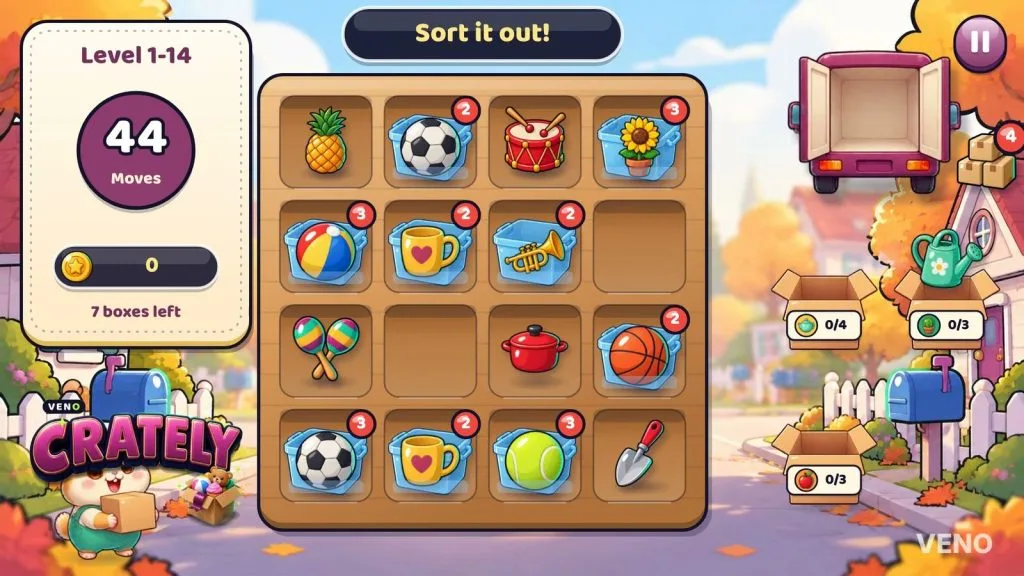
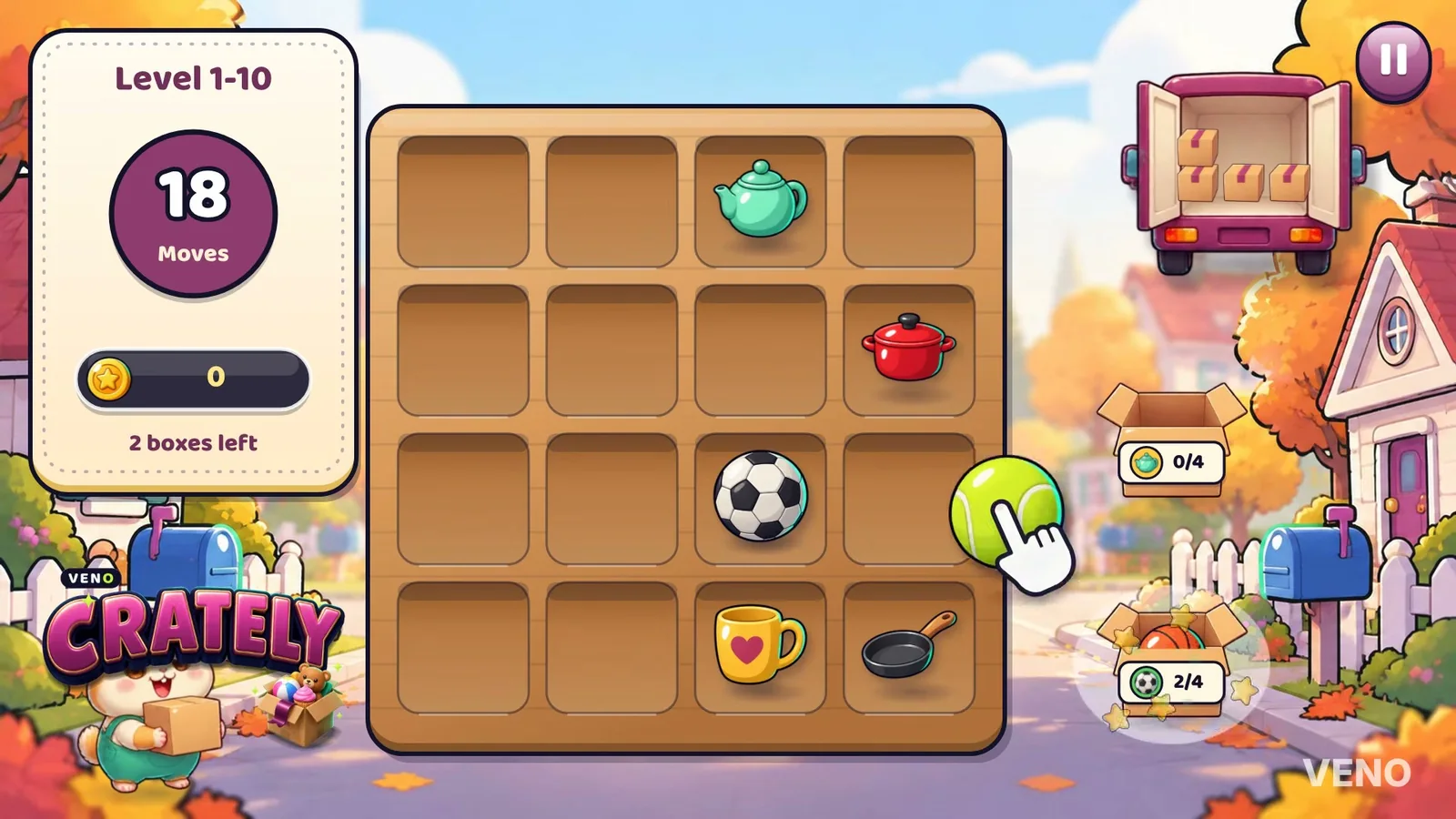
In VENO Crately each level is a wooden floor divided into tiles and covered with cute items: teddy bears, apples, teapots, guitars, cupcakes, sneakers and more. Three cardboard boxes stand open, each showing the picture of the category it accepts.
- Drag an item into the box with the same picture – or just tap it and it jumps into the right box by itself.
- Each successful action costs one move. A wrong drop simply slides the item back for free.
- A full box is sealed with plum tape and flies onto the moving truck, and the next box from the queue slides in.
- Close every box before you run out of moves to finish the level.
Many tiles hold a clear plastic tub with a red badge that shows how many items are stacked inside. Only the top item can be taken, so when the item you need is buried you move the top one to an empty tile and dig deeper.
What makes later levels harder
Sorting puzzles stay fresh by adding small rules on top of the simple one. In VENO Crately those rules arrive zone by zone:
- Maple Lane teaches the basics and stacked tubs.
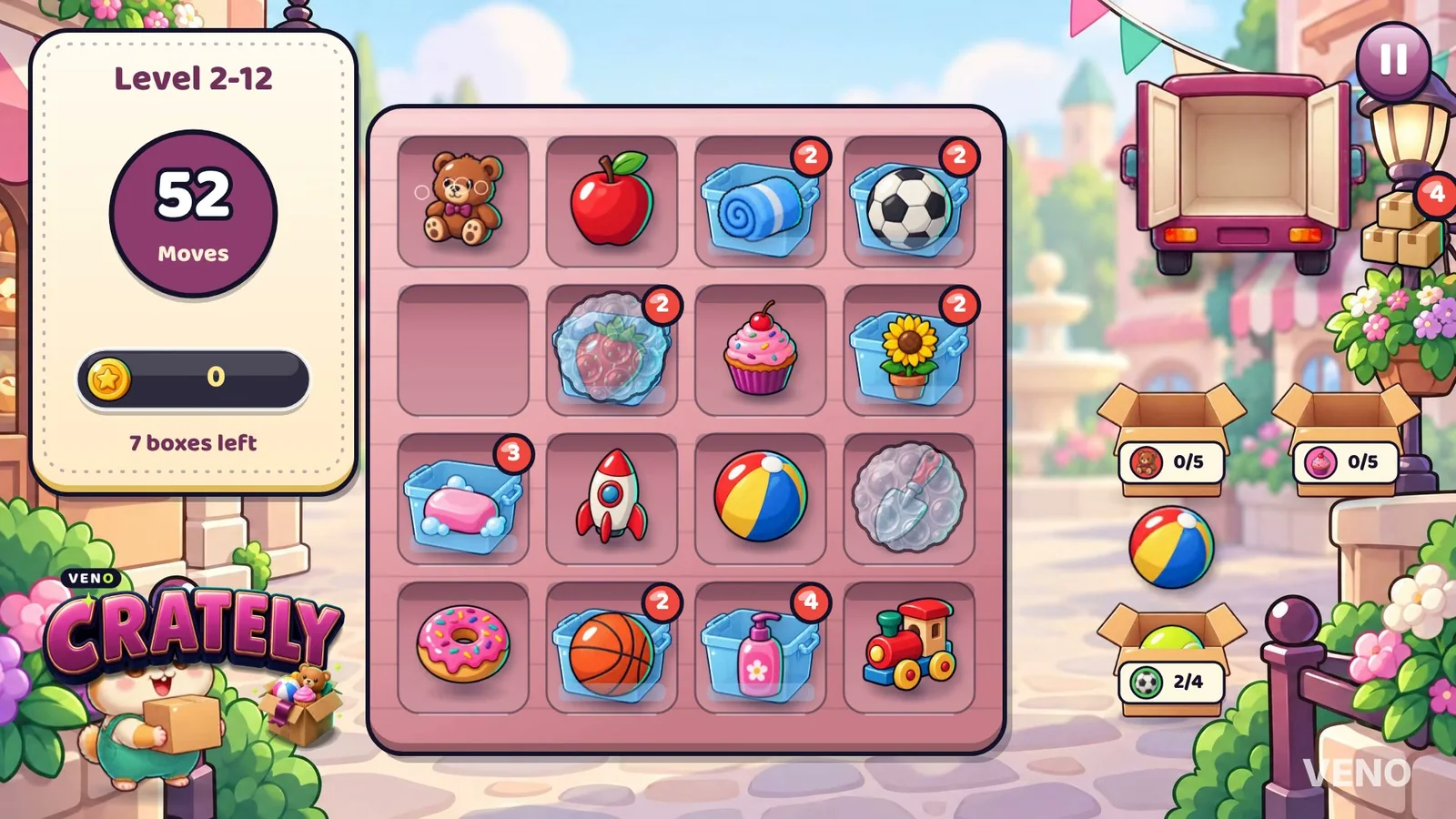
- Bakery Square adds bubble wrap that pops when you take an item from a tile next to it.
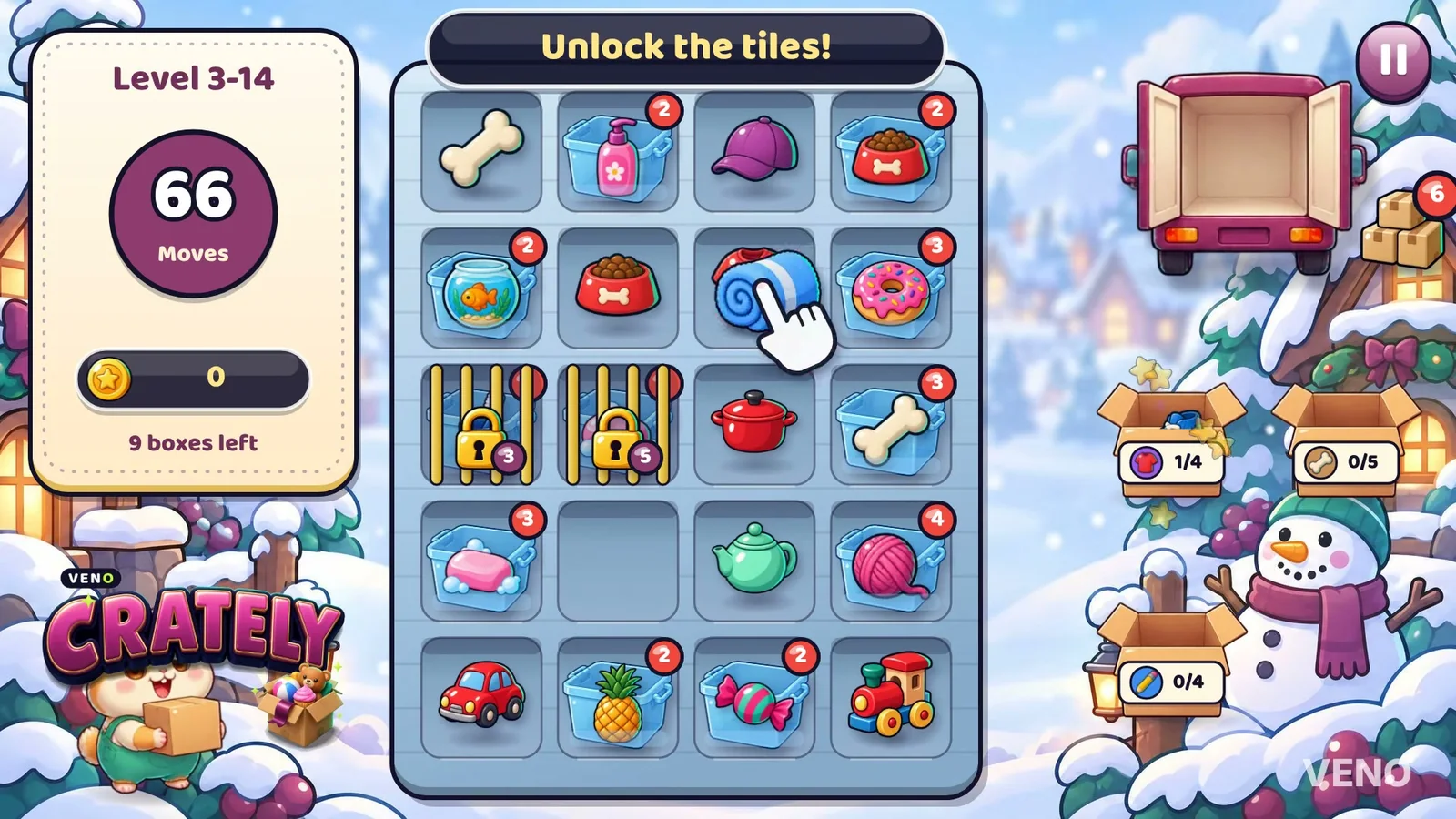
- Snowy Village adds golden padlocks that open only after a set number of boxes are closed, so packing order matters.
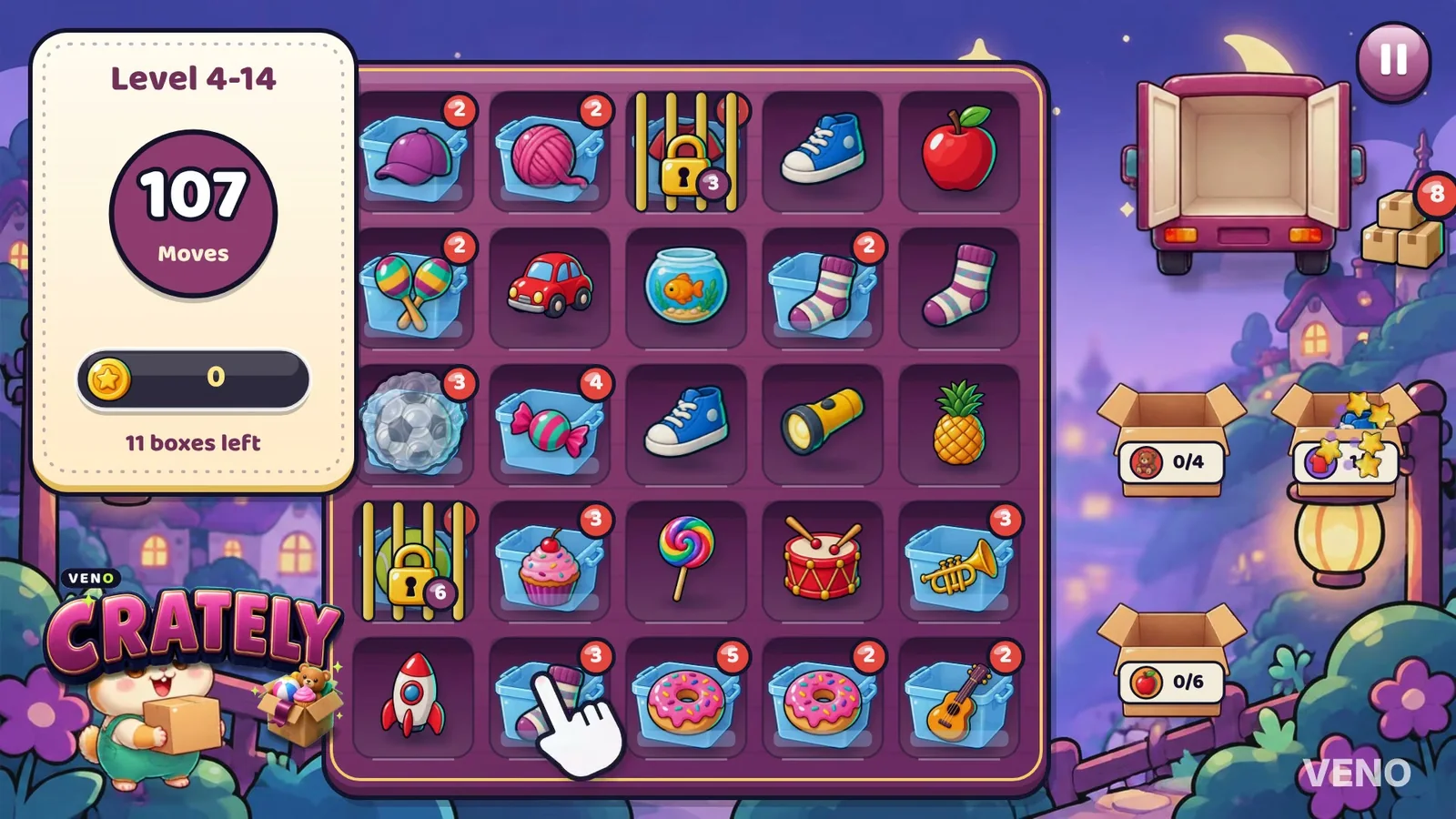
- Moonlit Hill grows the floor to 5×5 with deeper tubs and longer box queues.
Every level is checked by a solver, so there is always a way to finish. Helpers are there when you need them: a lightbulb hint, Undo, a magnet that pulls every reachable item of one category into its box, and a +1 slot that opens an extra box.
9 tips to clear sorting puzzles with moves to spare
- Look before the first move. Scan which categories the open boxes want and where those items sit. A few seconds of looking saves many moves.
- Always keep one free space. In every sorting game, a full board with no legal move is the only real dead end. Never fill the last empty tile or tube unless it finishes something.
- Dig where the most needed items are buried. Count what sits under each top item. Digging in the tub that hides two matching items is worth more than one.
- Park items in groups. When you must move an item aside, put it next to others of the same kind. Later the magnet or a single box can collect them in a row.
- Finish a box before starting a mess elsewhere. A sealed box frees its spot for the next one and often reveals what comes next in the queue.
- Plan for locks and wraps. If a padlock opens after a certain number of boxes, close the quickest boxes first. Take items next to bubble wrap to pop it early.
- Read the box queue. Knowing which box slides in next tells you which buried items will be needed soon.
- Tap when it is obvious, drag when it matters. Tapping is fast for clear moves; dragging lets you choose exactly where a parked item goes.
- Save helpers for the hard part. Undo and the hint are perfect for learning; keep the magnet and +1 box for the end of a long level where they save the stars.
Who sorting games are good for
- Kids practise grouping by category and colour with simple pictures and no reading needed. Undo and hints keep frustration low.
- Office workers on a break get a short, quiet puzzle that ends in a few minutes and leaves the mind tidier, not more wired.
- Older players enjoy calm pacing, large clear objects and a game that rewards thinking instead of speed.
- Phone players can sort with one thumb in portrait mode, anywhere.
There is no betting or gambling in sorting games like VENO Crately – coins are earned by finishing levels and are only used for in-game helpers.
Play it now
If you want a cosy sorting game you can start in seconds, VENO Crately runs free in your browser on phone, tablet and desktop, in ten languages, with nothing to install. There are 60 levels across Maple Lane, Bakery Square, Snowy Village and Moonlit Hill, with Bobo the hamster cheering every packed box and up to three stars per level.
FAQ
What are sorting games?
Sorting games are casual puzzles where you move items into the container of the same colour or category – balls into tubes, liquid into glasses, or toys into matching boxes – until everything is in order.
Why are sorting games so relaxing?
Each move removes a bit of visible mess, and full containers give clear “done” moments. The goal is simple but the best order takes thought, so you stay focused without time pressure.
Are sorting games good for your brain?
They exercise categorising, planning a few moves ahead and keeping track of what is hidden, all skills that sorting and classifying activities in early maths are also built on. They are a light mental workout, not a medical treatment.
What is the difference between ball sort and water sort?
Ball sort moves single coloured balls between tubes; water sort pours layers of coloured liquid between glasses. Both only let you move the top piece onto the same colour or into an empty container.
Can I play a sorting game free in my browser?
Yes. VENO Crately plays free in any modern browser on phone or computer, with no download and no sign-up.
Are sorting games good for kids?
Yes, especially picture-based ones. Kids can play without reading, learn to group by category, and use undo or hints when a level gets tricky.