
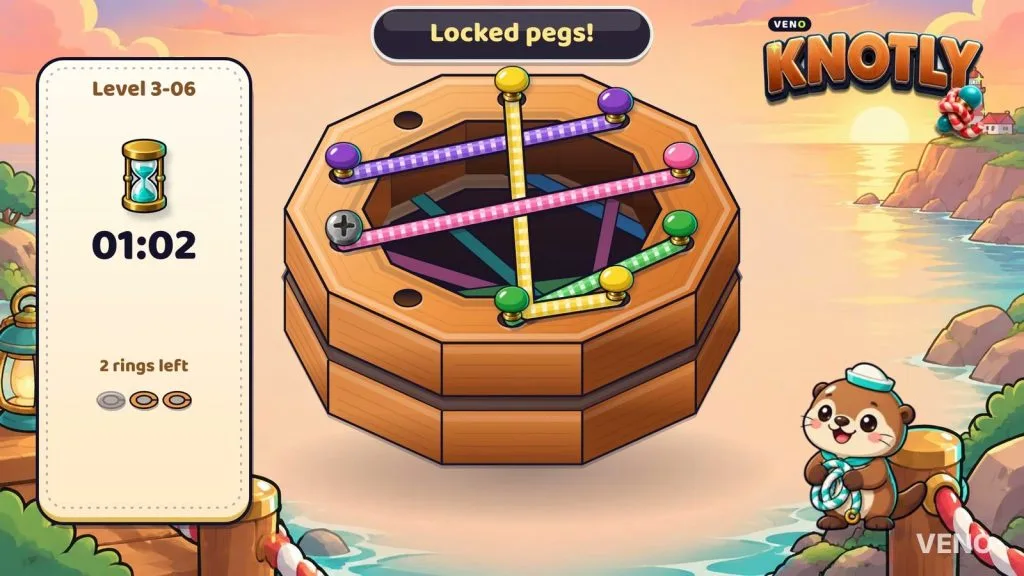
An untangle game is a logic puzzle where you move the ends of crossing lines, ropes or strings until nothing overlaps any more. The board looks like a mess at first, but every level hides a short, exact solution. The trick is learning to read which strand lies on top at each crossing – that single skill decides whether a rope slides free or gets stuck.
| Quick facts | |
|---|---|
| Genre | Logic puzzle / untangle puzzle |
| Goal | Remove every crossing so the ropes (or lines) come free |
| Classic ancestor | Planarity, a free web game from 2005 |
| Math behind it | Planar graphs and knot diagrams (Reidemeister moves) |
| Key skill | Reading over and under at each crossing, then choosing the order |
| Play free in a browser | VENO Knotly (rope tower puzzle, 60 levels, no install) |
▶️ Watch the gameplay: VENO Knotly on YouTube · Shorts
Where untangle games came from
The best-known early untangle game is Planarity, a free web game made in 2005 by John Tantalo from a concept by mathematician Mary Radcliffe. It shows a jumble of dots joined by straight lines. You drag the dots around until no two lines cross. Each level is built so that a crossing-free layout always exists – in maths terms, the picture is a planar graph.
Planarity spread quickly and inspired many versions. A puzzle simply called Untangle is part of Simon Tatham’s free Portable Puzzle Collection, and dozens of “untangle the lines” games followed on the web and on phones.
Later the idea picked up a physical feel. Instead of thin lines, newer games use ropes, wires and yarn with real thickness, so each crossing has a top strand and a bottom strand. That small change adds a whole new layer of logic, and it is where rope puzzles like VENO Knotly live.
The over-under rule, explained with knot theory
In a flat “untangle the lines” game, a crossing is just a crossing. With ropes, it matters which rope is on top. Mathematicians who study knots draw them exactly this way: a knot diagram shows every crossing with one strand passing over the other.
In 1927 the German mathematician Kurt Reidemeister described three simple moves that change a knot diagram without changing the knot itself. The second one is the key to rope puzzles:
- If one strand passes over another strand twice in a row, the two crossings cancel. You can slide the strand off and both crossings disappear.
- If it passes over once and under once, the strands are linked like two hooks. No amount of sliding removes those crossings – you have to move an end around instead.
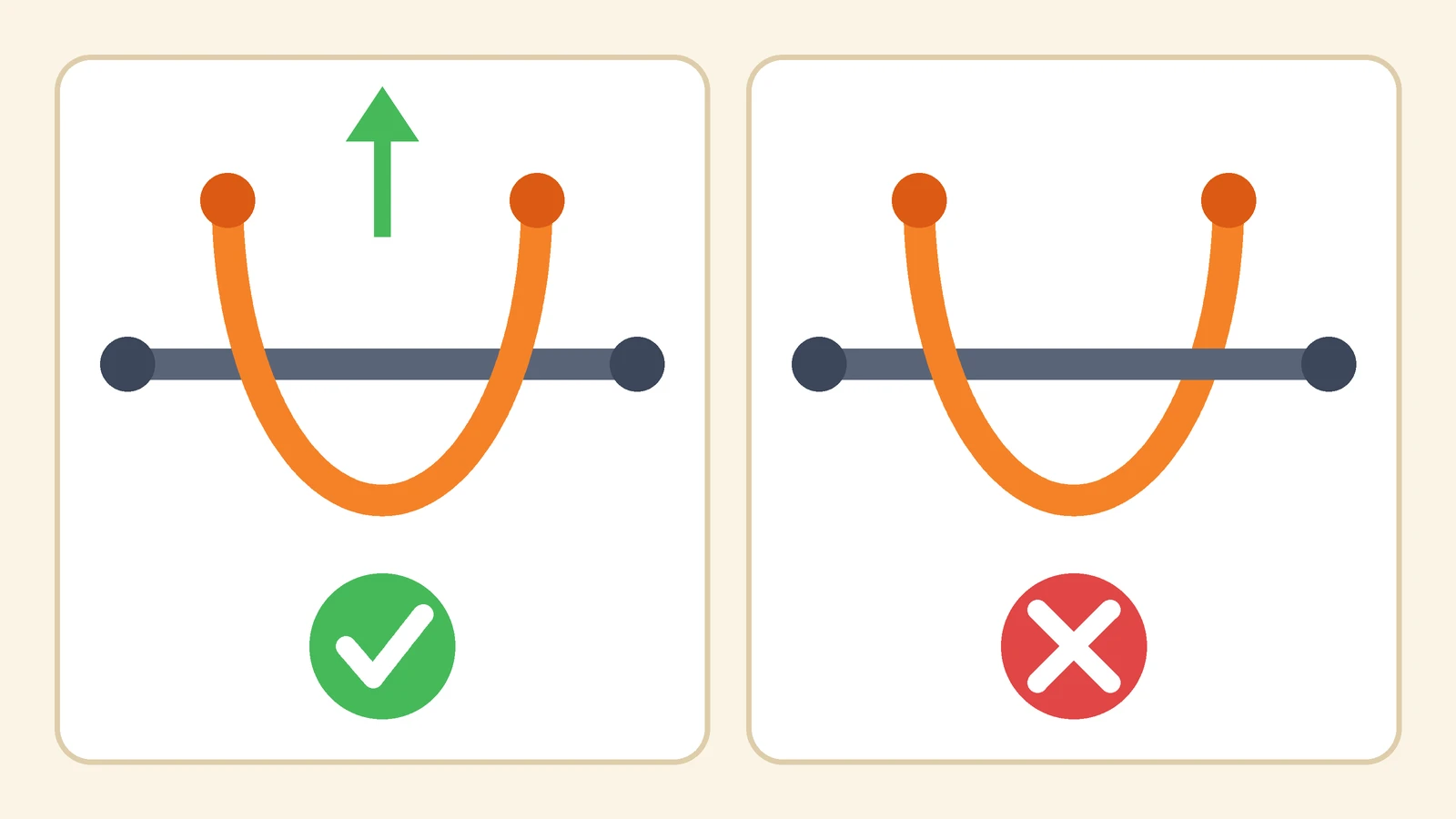
VENO Knotly turns this into its one rule. The end you are holding always passes over every other rope. So when you drop a peg into a new hole, ask yourself: will this rope now cross the others over-over (it slides free), or over-under (it hooks)? A rope that crosses nothing at all pops off its pegs and flies away.
| Crossing pattern | What happens | What to do |
|---|---|---|
| No crossings | Rope pops off and flies away | Nothing – it is solved |
| Over + over | The two crossings cancel, rope slides free | Good move, take it |
| Over + under | Ropes hook around each other | Move the other end, or go around the other side |
| Under + under | Still stuck under the other rope | Free the rope on top first |
How a rope tower puzzle plays
In VENO Knotly each level is a tower of glossy wooden rings. Candy pegs sit in holes around the rim of the top ring, and braided ropes join pairs of pegs across the hollow middle.
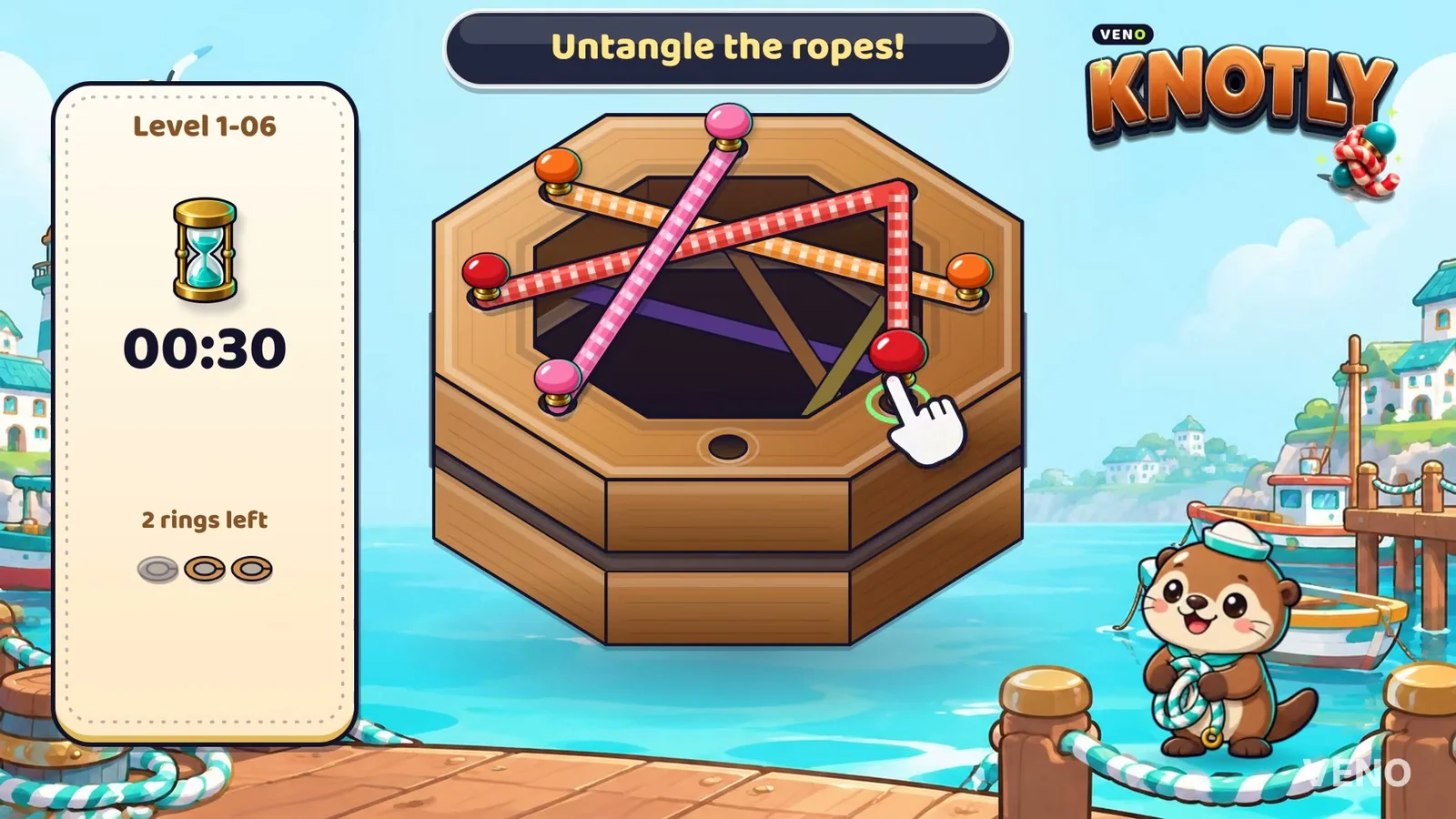
- Press and hold a peg and drag it to any empty hole.
- Let go. The rope pulls itself tight along its new path.
- Check the crossings. A rope that no longer crosses any other rope pops off and frees its two holes.
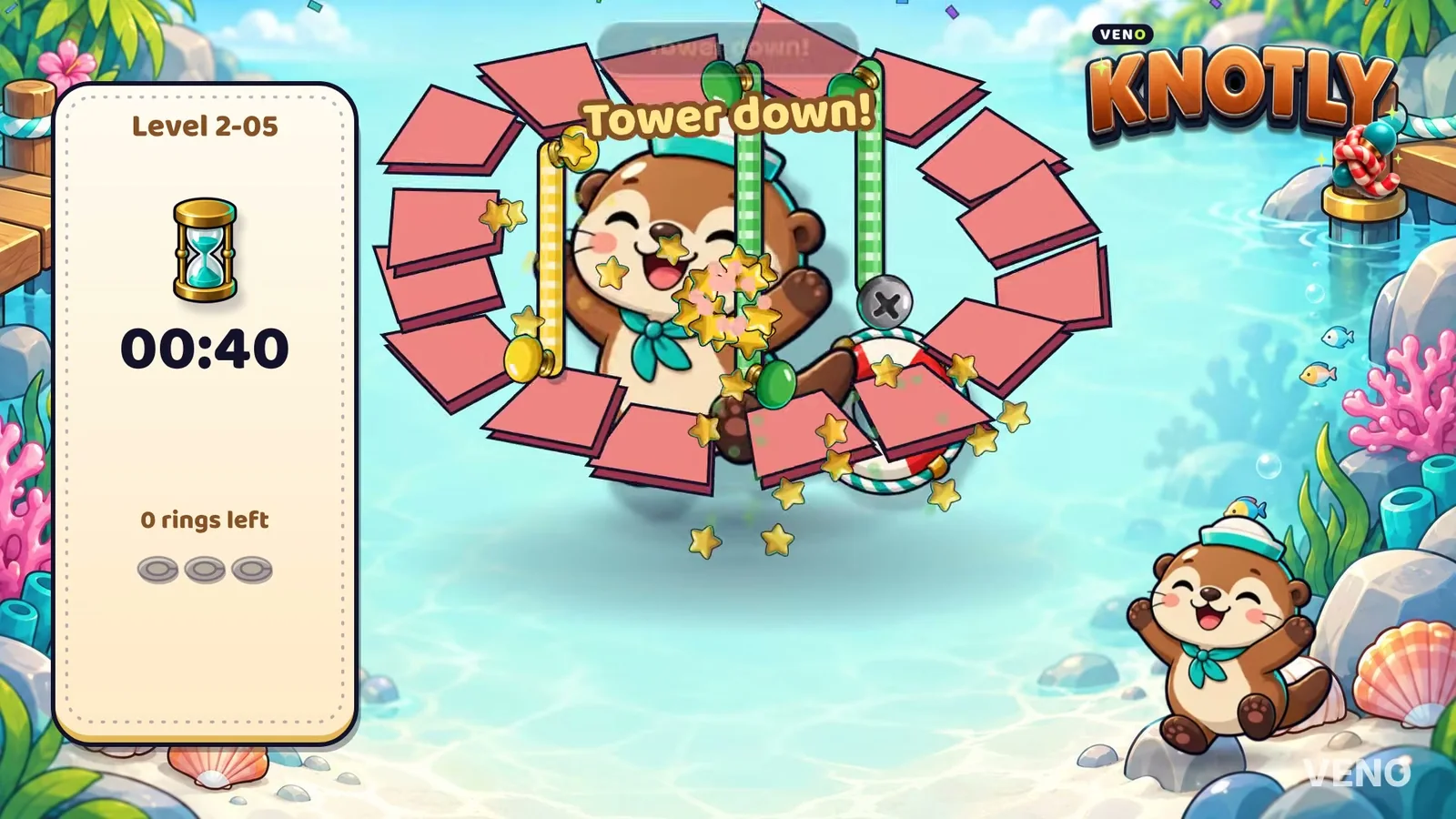
- Clear the ring. When every rope is gone, the ring breaks into planks and the next ring rises.
- Topple the tower before the hourglass runs out.
Dropping a peg outside a hole, or on a filled hole, just sends it back – so a slip never costs you a move.
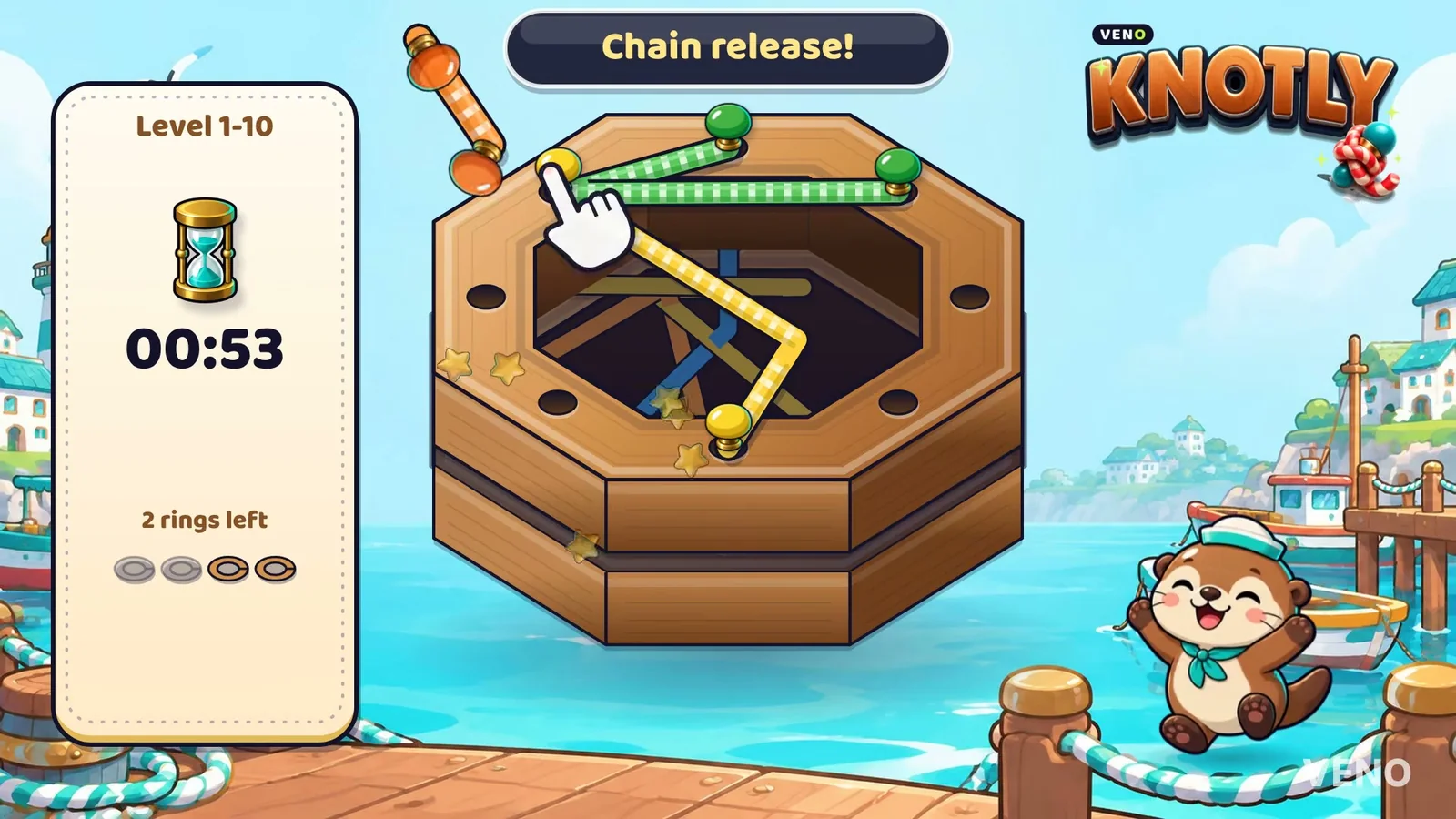
The best moments are chain releases. Free the rope in the middle of a pile first and two or three ropes can fly away in a single move – the game shows a “Triple!” when three go at once.
What makes later levels harder
Rope puzzles stay fresh by changing the board rather than the rule. In VENO Knotly that means:
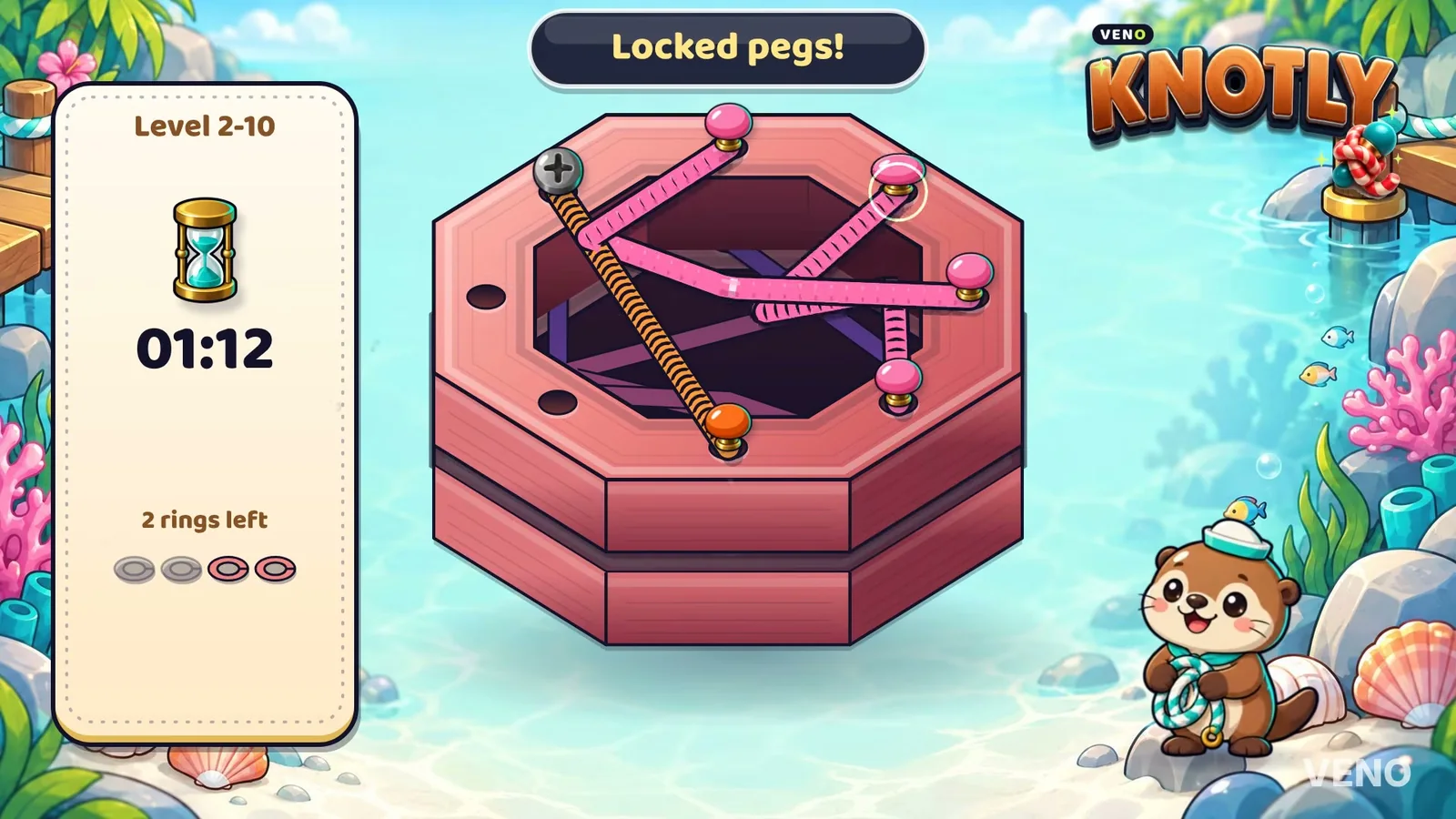
- Brass screw pegs that cannot be moved, so you have to work around them.
- Two ropes of the same colour, which makes it harder to follow which end belongs to which rope.
- Bigger rings with 10 and 12 holes and up to five ropes.
- Taller towers, growing from two rings to six, across four seaside zones: Sunny Harbor, Coral Lagoon, Sunset Lighthouse and Starry Pier.
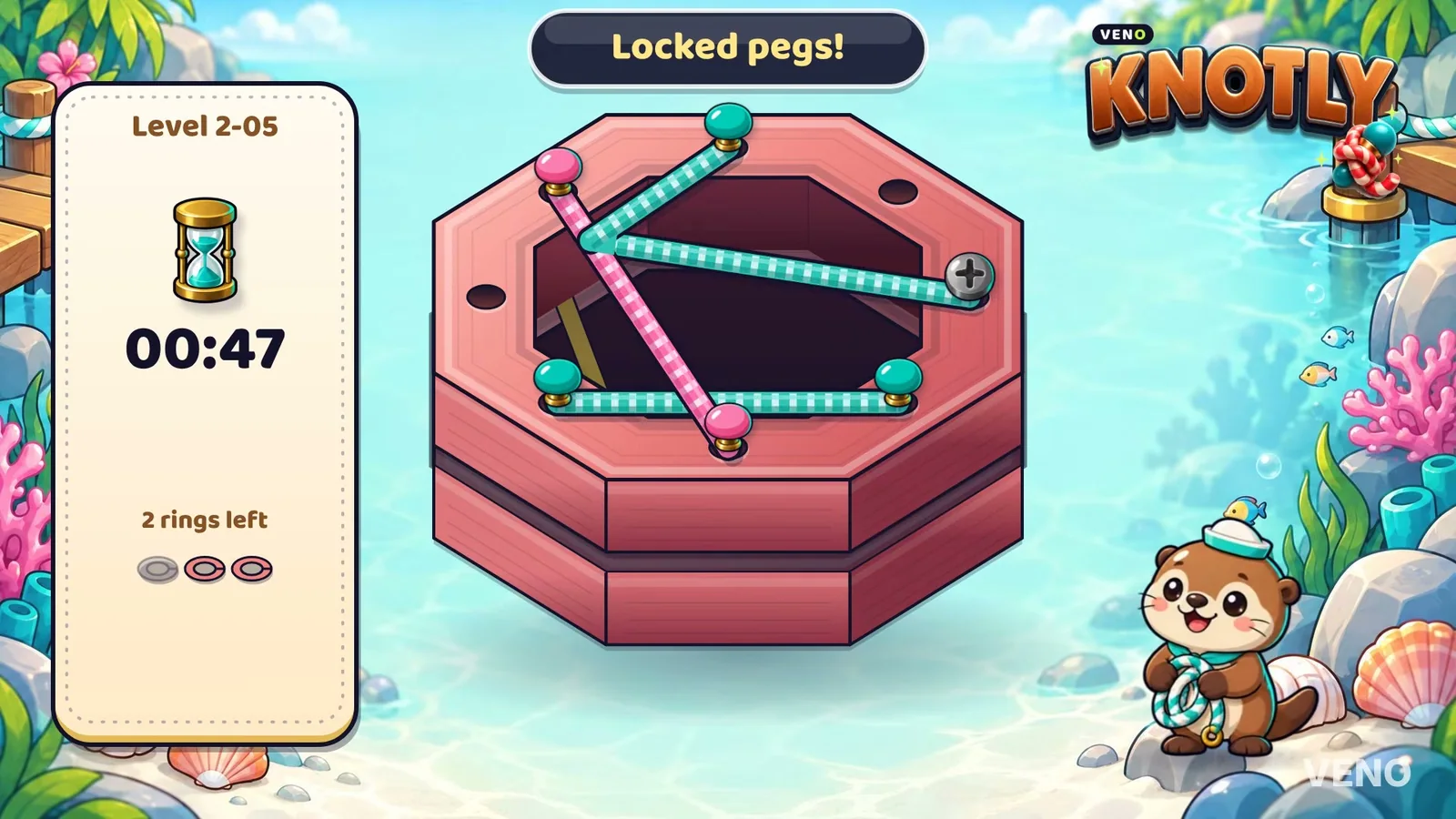
Every ring is generated so that it can always be solved, and each one has a known shortest solution – so if you feel stuck, there is always a way out.
9 tips to clear untangle puzzles in fewer moves
- Find the free rope first. Look for a rope that crosses only one or two others. It is usually one move from flying away.
- Free the middle of a pile. A rope that everything else lies on top of is the cork in the bottle. Remove it and a chain release often follows.
- Count the crossings before you drop. Trace the new path in your head: over-over is good, over-under means a hook.
- Go around the other side. If the short way creates a hook, an empty hole on the far side of the ring often gives a clean path.
- Move the top rope, not the trapped one. A rope stuck under others will not come free until the ropes on top of it move.
- Plan around locked pegs. A brass peg will never move, so treat its rope as fixed and untangle everything else around it.
- Follow same-colour ropes end to end. Before moving one of a matching pair, check which two pegs it really joins.
- Keep an empty hole handy. A free hole next to a busy area gives you room to fix mistakes.
- Use helpers with a plan. Undo takes back a move, the lightbulb hint shows the best peg and target hole, and the scissors cut one rope away – save the scissors for the ring that would otherwise cost you the stars.
Untangle games compared
| Type | What you move | Does over/under matter? | Typical goal |
|---|---|---|---|
| Line untangle (Planarity-style) | Dots joined by thin lines | No | Zero crossings on screen |
| Yarn and wool puzzles | Coloured threads or spools | Sometimes | Sort or wind threads in the right order |
| Rope tower puzzles (VENO Knotly) | Pegs holding thick ropes | Yes, it is the core rule | Free every rope and topple the tower |
Rope towers sit closest to real knot logic, which is why they reward careful reading more than fast tapping. With a timer and stars on top, they also give a satisfying “one more level” pace.
Play it now
If you want to try the over-under rule for yourself, VENO Knotly is a free rope untangle puzzle that runs in your browser on phone, tablet and desktop, in ten languages, with nothing to install. There are 60 levels, Pip the little sea otter cheering you on, and up to three stars and coins for every level you finish with time to spare.
FAQ
What is an untangle game?
An untangle game is a logic puzzle where you move the ends of crossing lines or ropes until none of them overlap. Every level has a solution, and the fun is finding it in as few moves as possible.
Who made the first untangle game?
The best-known early one is Planarity, a free web game from 2005 by John Tantalo, based on a concept by Mary Radcliffe. It uses dots and straight lines on a planar graph.
Why does a rope slide free when it goes over twice?
Two over-crossings in a row cancel out, the same way knot theory’s second Reidemeister move removes a pair of crossings. Over once and under once makes a hook that sliding cannot undo.
Are untangle puzzles always solvable?
Well-designed ones are. In VENO Knotly every ring is generated to be solvable and has a known shortest solution.
Can I play an untangle game for free in the browser?
Yes. VENO Knotly plays free in any modern browser on phone or computer, with no download and no sign-up.
Are untangle games good for kids?
They suit kids who like calm logic puzzles: one simple move, no reading needed to play, and helpers like undo and hint when a ring gets tricky.