Zero-G is a free browser space MMO set in a 1:1 scale Solar System whose Moon and Mars surfaces come from NASA elevation data. You open it in a tab, with nothing to download, fly a ship under Newtonian physics, mine asteroids by hand and, since November 2026, build your own base on real lunar terrain. It is still in public alpha, and it is one of the most ambitious things anyone has built with Three.js and WebGL.
This guide covers what the game is, how to get started, how the new planetary bases work, and what web game developers can take away from the way it handles huge terrain in a browser.
Zero-G at a glance
| What | Hard-science space MMO, economy sim and co-op strategy |
| Developer | Zero G Team, an independent studio in Rome, Italy, led by Giuseppe Caggese |
| Platforms | Any web browser on desktop or mobile, no download or install |
| Price | Free to play, with optional premium content |
| Status | Public alpha since 19 January 2026; Alpha 5.7.2 released 10 November 2026 |
| Tech | HTML5, WebGL, Three.js and Node.js on an in-house engine, one persistent shard |
| Language | English interface; an in-game AI assistant answers questions in any language |
| PvP | None, the game is co-op by design |
| Official site | space.zerog.live |
What kind of game is Zero-G?
Zero-G puts every player in one shared, always-on Solar System. According to the official press kit, planets, moons and orbits are built at 1:1 scale, ships fly with inertia and manual controls, and the universe runs 24/7 with no seasons, wipes or resets. Ships keep their own history, XP and modifications.
The story is set in the year 2264, after Earth united behind faster-than-light travel. The in-game clock runs at 100 times real speed, and the team ties the full launch to the moment that clock reaches 2264, which it estimates will happen around November 2027.
There is no player-versus-player combat. Instead, the design pushes people to work together: some missions cannot be finished by one pilot alone, and an Alpha 5.6 feature lets one pilot channel shields into another ship. As of 6 November 2026 the team counted 1,887 registered pilots and 25,722 missions flown.
How to start playing in your browser
Zero-G is built for quick sessions on modest hardware. The press kit says you can be flying in about 30 seconds and that it runs on old laptops and phones. A simple first session looks like this:
- Open space.zerog.live in a desktop or mobile browser and create a pilot.
- Follow the tutorial to learn manual flight; remember that ships keep drifting until you brake.
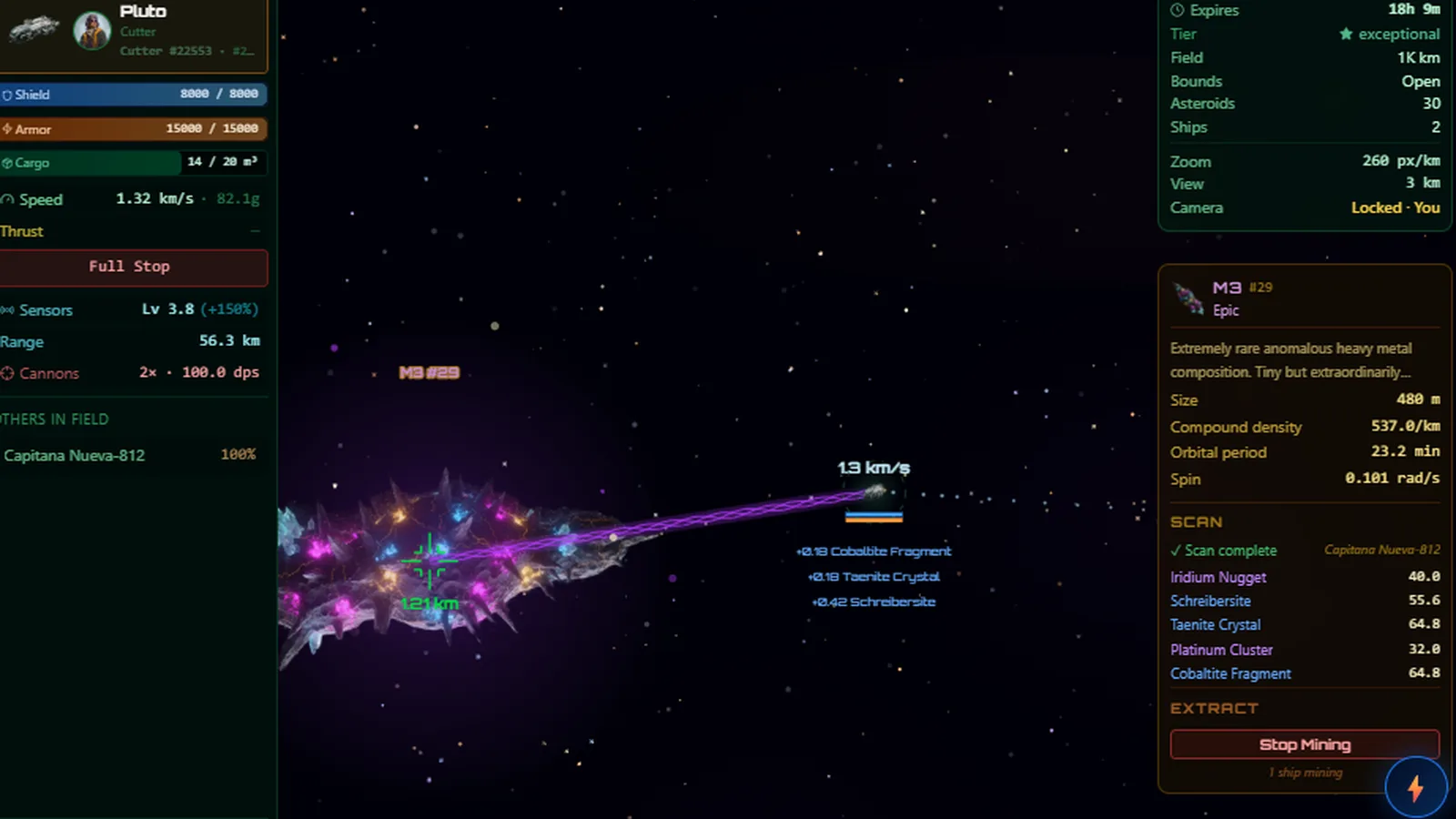
- Fly out to an asteroid field and try hand-flown mining, where collisions matter.
- Bring the ore back, refine it and look at the synthesis blueprints to see what it can become.
- Visit the player-run Auction House; prices depend on where you sell, so location is part of the game.
- Join a Venture (a player group) to pool effort into shared starbases and co-op missions.
If you are on a slow connection, the Data Saver option added in Alpha 5.7.2 holds back video and loads images only when needed.
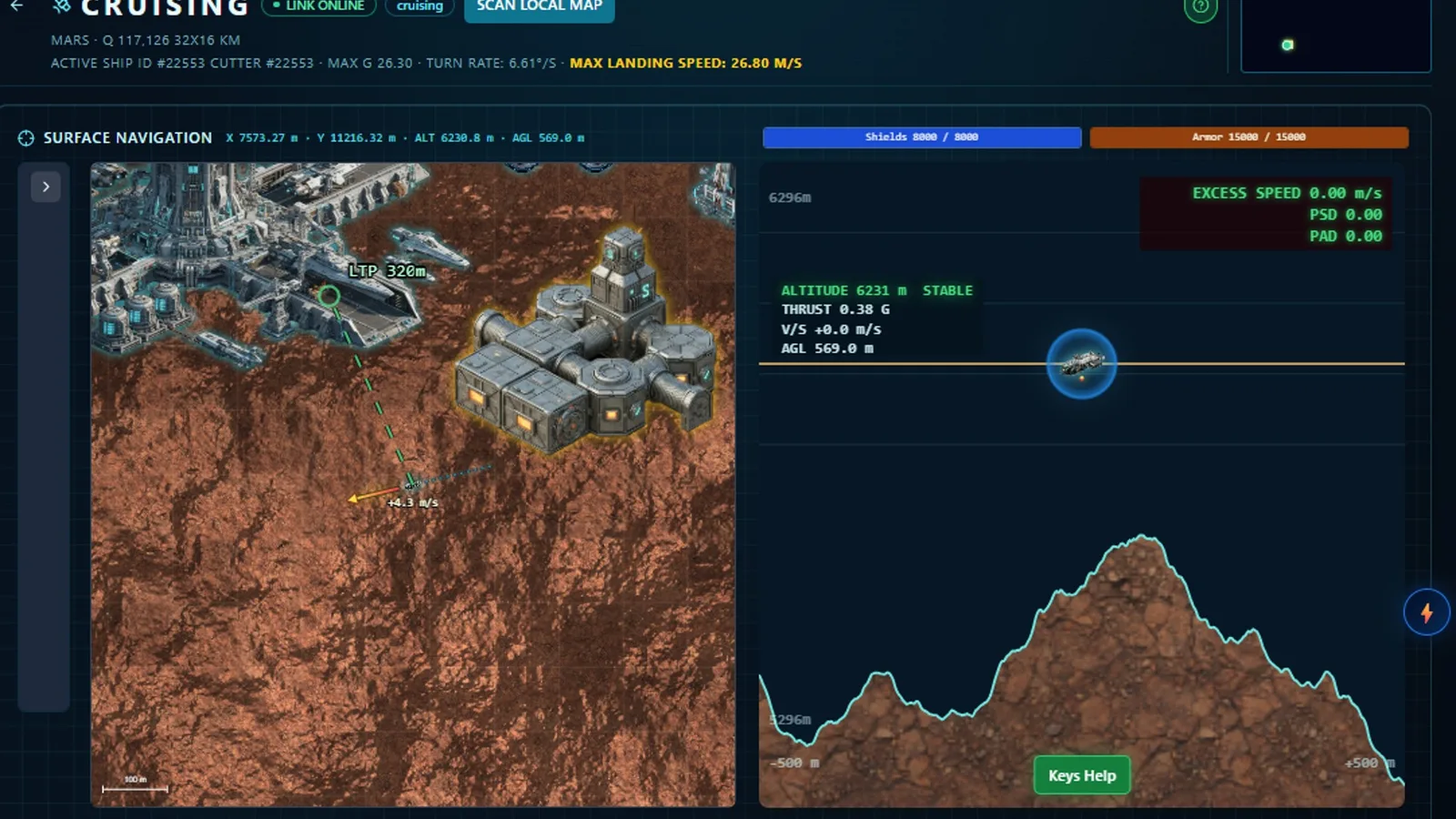
Real Moon and Mars terrain from NASA data
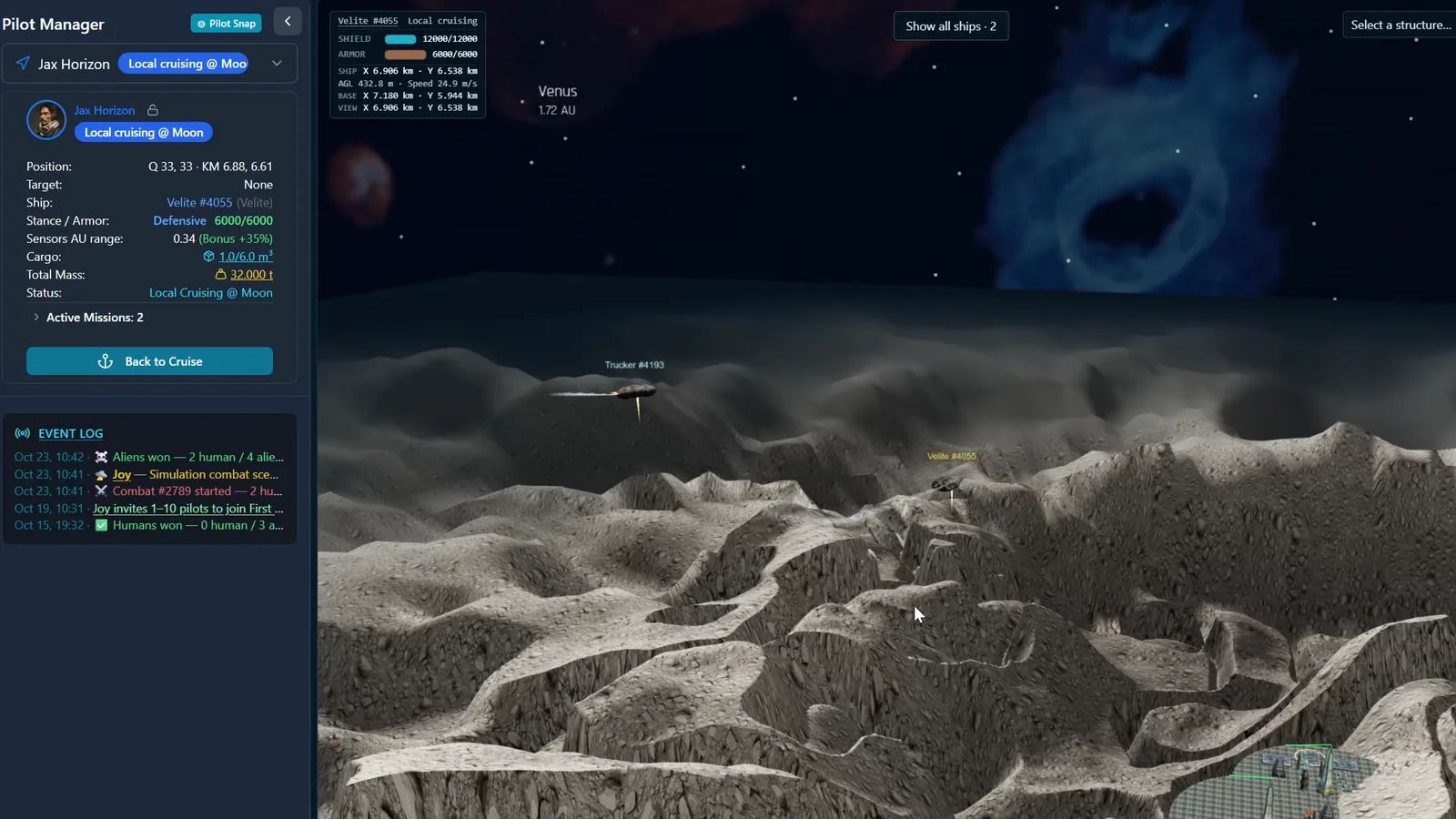
The surfaces you land on are not invented. The Moon uses elevation data from LOLA, the Lunar Orbiter Laser Altimeter on NASA’s Lunar Reconnaissance Orbiter. Mars uses MOLA, the Mars Orbiter Laser Altimeter from Mars Global Surveyor. The team notes that Zero-G is an independent project and is not affiliated with or endorsed by NASA.
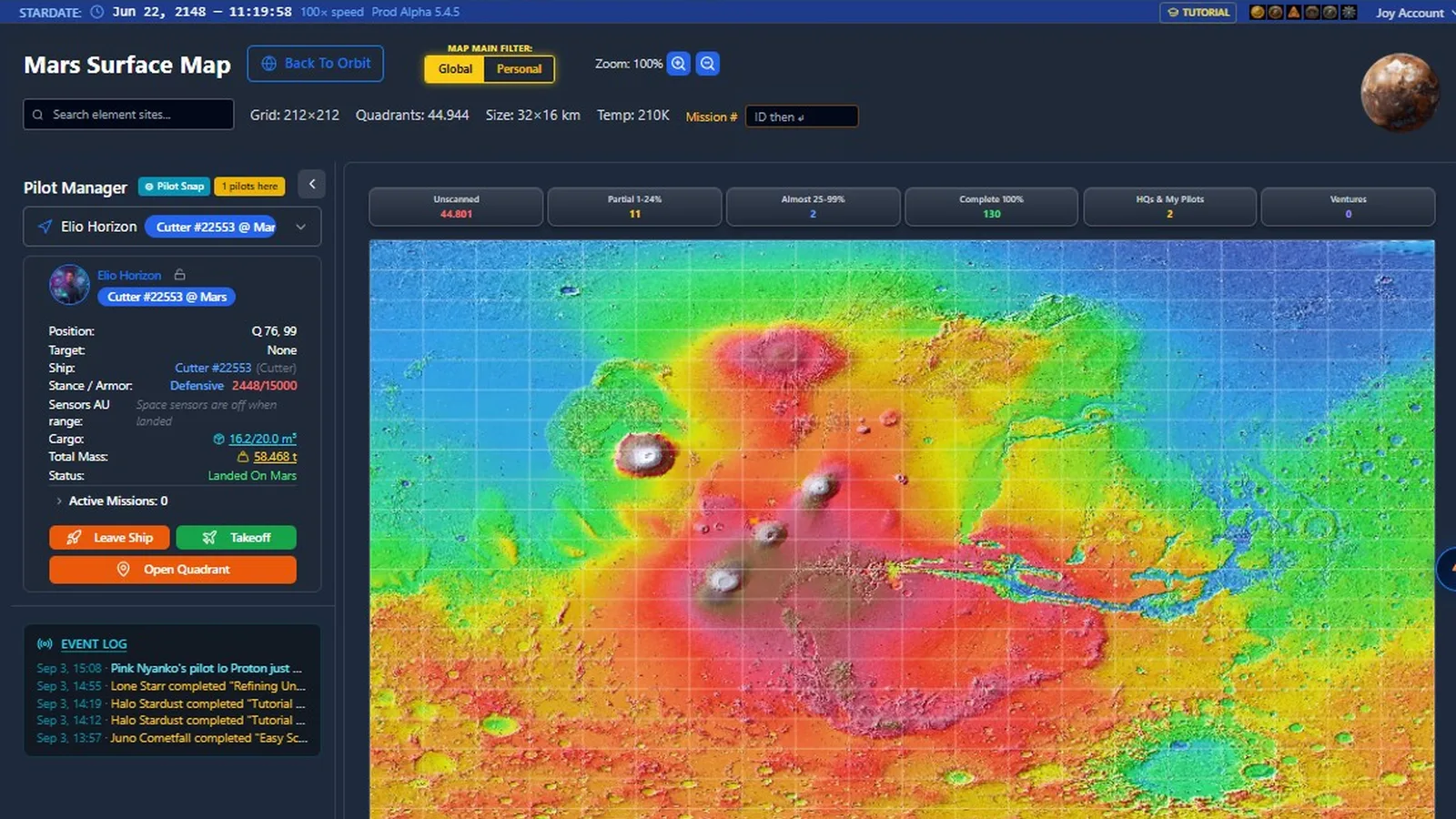
Mars is split into a grid of 212 × 212 quadrants, each 32 × 16 km. A quadrant has to be surveyed by pilots before anyone can buy land on it, so exploring is a real job in the economy, not just sightseeing.
How planetary bases work after the Terra Firma update
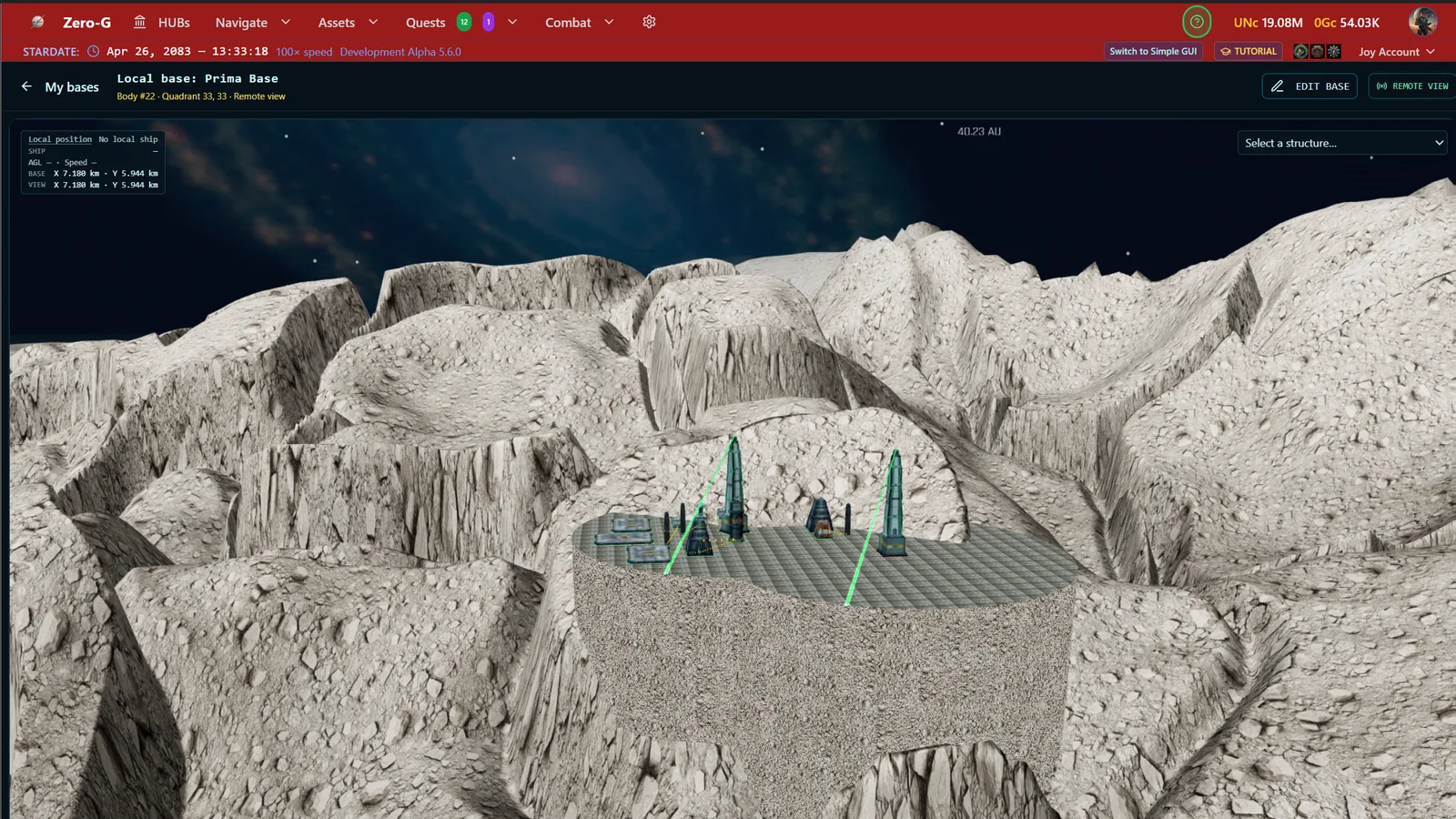
Alpha 5.7.0, called Terra Firma, arrived on 2 November 2026 and added player-owned land. The official bases guide explains the steps:
- Buy a licence. A General Land Office sells you a circle 100 metres across at coordinates you choose. There are offices at the Moon HQ and at Ceres Ophir Port, and you can only buy in a quadrant that has been fully surveyed and published.
- Buy a Pharus beacon. The Pharus Alpha is sold at the General Store at Grottaglie. It powers itself, so it needs no reactor or cable.
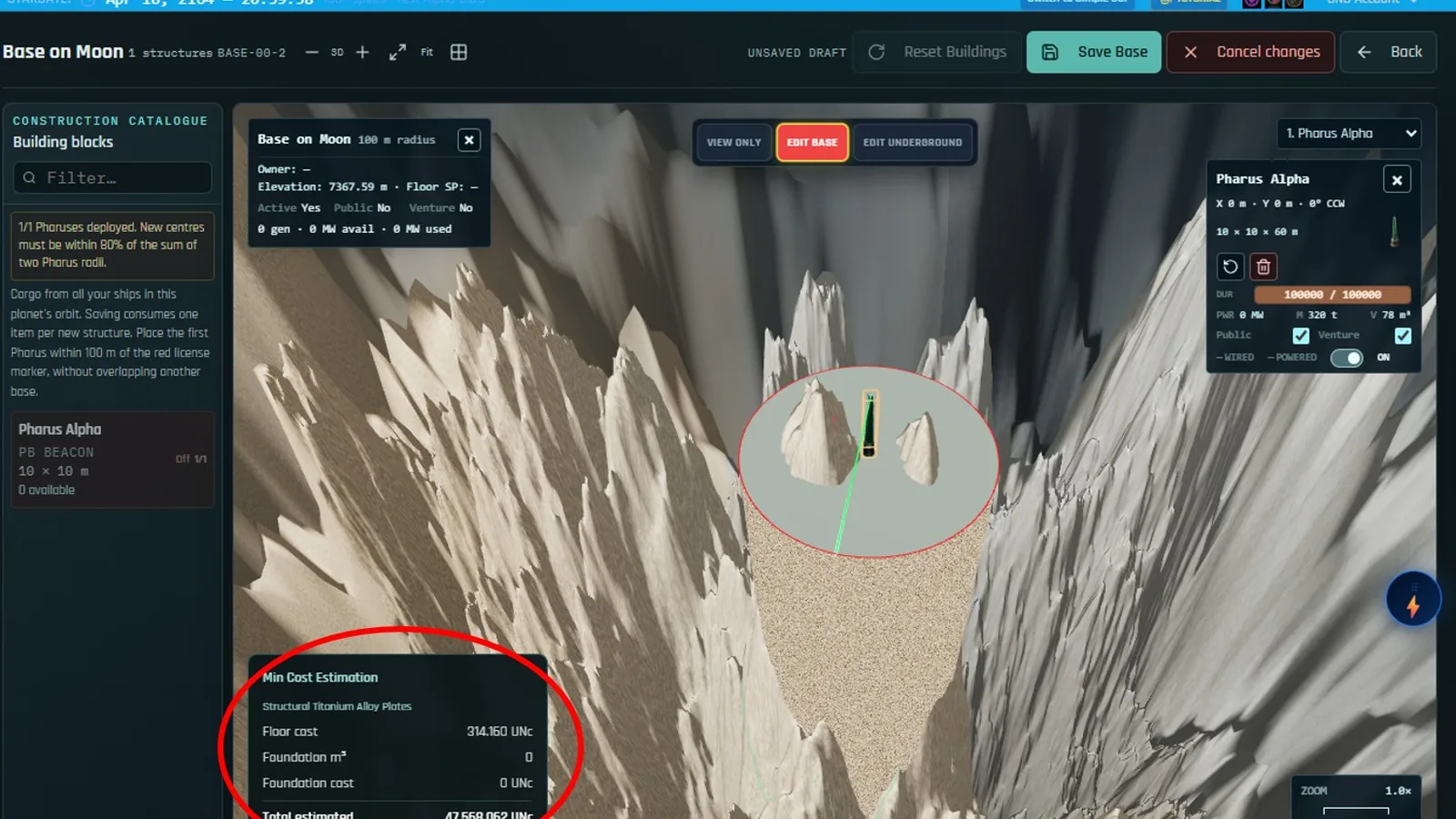
- Place the platform. The Pharus lays a flat platform 100 metres across, and any ground below that level is filled in.
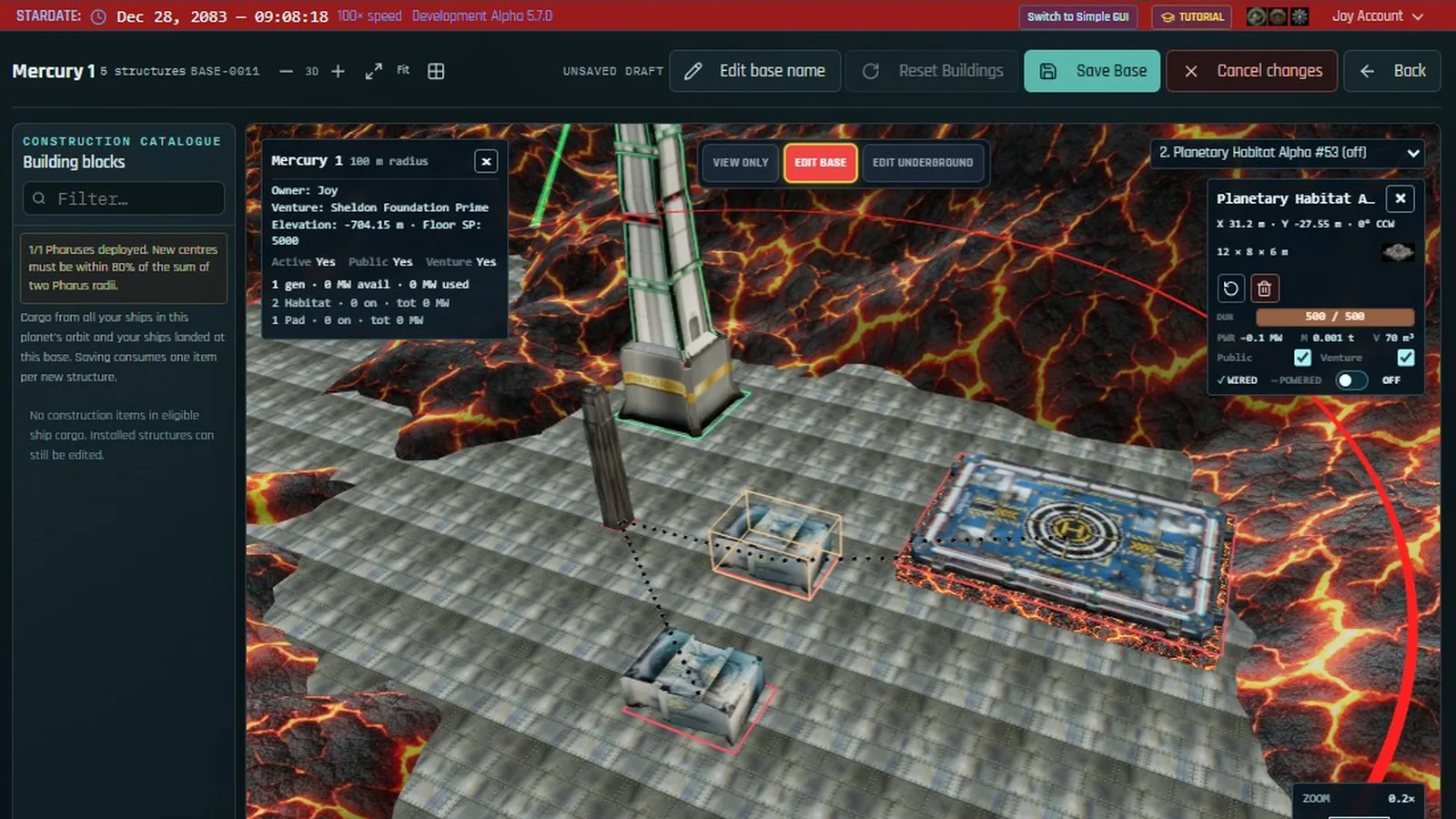
- Add the starter modules. The smallest working base is a Fornax Alpha reactor (+500 kW), a Domus Alpha habitat (100 kW), a Horreum Minus store (100 kW) and a Pulvinar Medium landing pad (140 kW). With the Pharus, that is about 143 m³ of cargo.
- Wire everything. Each structure must be cabled to a generator.
Why flat ground is worth money
The platform’s cost depends on how much terrain has to be filled to make it level, and the estimate updates live as you drag the Pharus around. Flat ground is cheap; a thin peak can cost tens of millions of the in-game currency. Two spots on the same claim can carry very different prices.
A quick bit of geometry shows why. A 100-metre circle covers about 7,854 m². If one quarter of it (about 1,963.5 m²) sits over a dip averaging 2 metres deep, that is roughly 3,927 m³ of fill before you build anything. The game has its own pricing, but the idea is the same: every metre of slope adds volume.
Quick tips for your first base
| Choice | Cheaper option | Why it matters |
|---|---|---|
| Where to buy | The Moon | The guide says it is usually the cheapest body for land |
| Site | Flat, low ground | Less fill under the platform |
| Second licence | Plan before you buy | Each extra licence on the same planet costs double |
| Landing pad | Pulvinar Medium | Pulvinar Maior takes bigger ships but draws 400 kW, so it needs a second reactor |
| Wiring | Chain for budget, star for safety | A star layout costs more but fails more gracefully |
Alpha 5.7.2, released 10 November 2026, opened Mars land offices, added Sonda probes that prospect for 20 new Planetary Compounds and a base data centre called Nexus.
What web game developers can learn from Zero-G
Zero-G runs on HTML5, WebGL, Three.js and Node.js with no commercial engine, which makes it a useful case study for anyone building 3D on the web.
- Never send the whole world. The developer’s own figures put one Mercury quadrant at its finest detail at about 7.7 TB, while one example view needed only around 2.2 MiB in the browser. Stream only what the player needs at their current position and zoom.
- Fill detail between real measurements. NASA altimeter data has a fixed resolution, so the small bumps under a landing strut have to be generated between the measured points.
- Turn hidden cost into visible feedback. A one-metre height change across 100 metres is hard to judge by eye, so the live cost estimate on the Pharus does the judging for the player.
- Measure, then trust. Useful numbers to track are transfer size, memory used by the current terrain patch, and how long it takes to rebuild after a reload. Players should find their foundation exactly where they left it.
- Respect weak devices. A data-saver mode and touch controls let the same build serve old phones and desktops.
Is Zero-G worth trying?
If you like slow, thoughtful space games about logistics, mining and trading, and you want to play with friends rather than against them, Zero-G is easy to try because it costs nothing and needs no install. Keep in mind that it is an alpha: features change often, the art is described by the team as AI-assisted for now, and the next big step, Alpha 6 “Research”, has no date yet. For web developers, it is worth a few minutes just to see how far a browser tab can go.
FAQ
Is Zero-G free to play?
Yes. Zero-G is free to play in any browser, with optional premium content that the team says funds development.
Does Zero-G work on mobile?
Yes. Mobile support arrived in June 2026, and the game has touch controls, so it runs on phones as well as desktop browsers.
Is the Moon in Zero-G real?
The Moon’s relief comes from NASA LOLA elevation data and Mars from MOLA data, with finer detail generated between the measured points.
Is there PvP in Zero-G?
No. The game is co-op by design, with shared starbases and missions that need more than one pilot.
What engine does Zero-G use?
It uses an in-house engine built on HTML5, WebGL and Three.js, with Node.js on the server side.
When is the full release?
There is no fixed date. The team ties the full launch to the in-game clock reaching the year 2264, estimated around November 2027.