
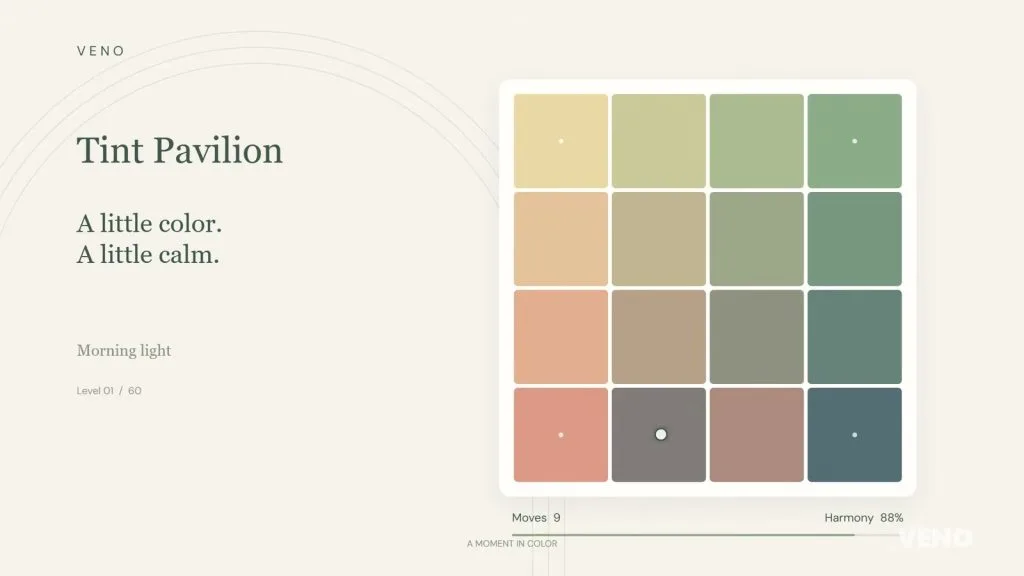
A color gradient puzzle is a game where tiles of slightly different shades are shuffled on a grid and you swap them until every color sits in the right place, forming one smooth blend from corner to corner. There is no word to spell and no number to add: the only clue is your eye. The idea started as a color-vision test in the 1940s and became one of the calmest puzzle genres on phones and in the browser.
▶ See a real board go from scattered to 100% harmony: VENO Tint Pavilion gameplay on YouTube · vertical Shorts version
Quick facts
| Genre | Color sorting / hue puzzle |
| Core action | Swap two tiles until the board forms a smooth gradient |
| Ancestor | Farnsworth–Munsell 100 Hue test (1940s) |
| Famous examples | Blendoku (2013), I Love Hue (2016) |
| Skill used | Comparing hue, lightness and saturation |
| Time pressure | Usually none — it is a relaxing genre |
| Try it free | VENO Tint Pavilion, in your browser |
What is a color gradient puzzle?
Picture a 4×4 grid. The top-left tile is pale butter yellow, the top-right is sage green, the bottom-left is coral and the bottom-right is slate blue. Every tile in between should be a mix of its neighbors. Now shuffle the middle tiles. Your job is to put them back.
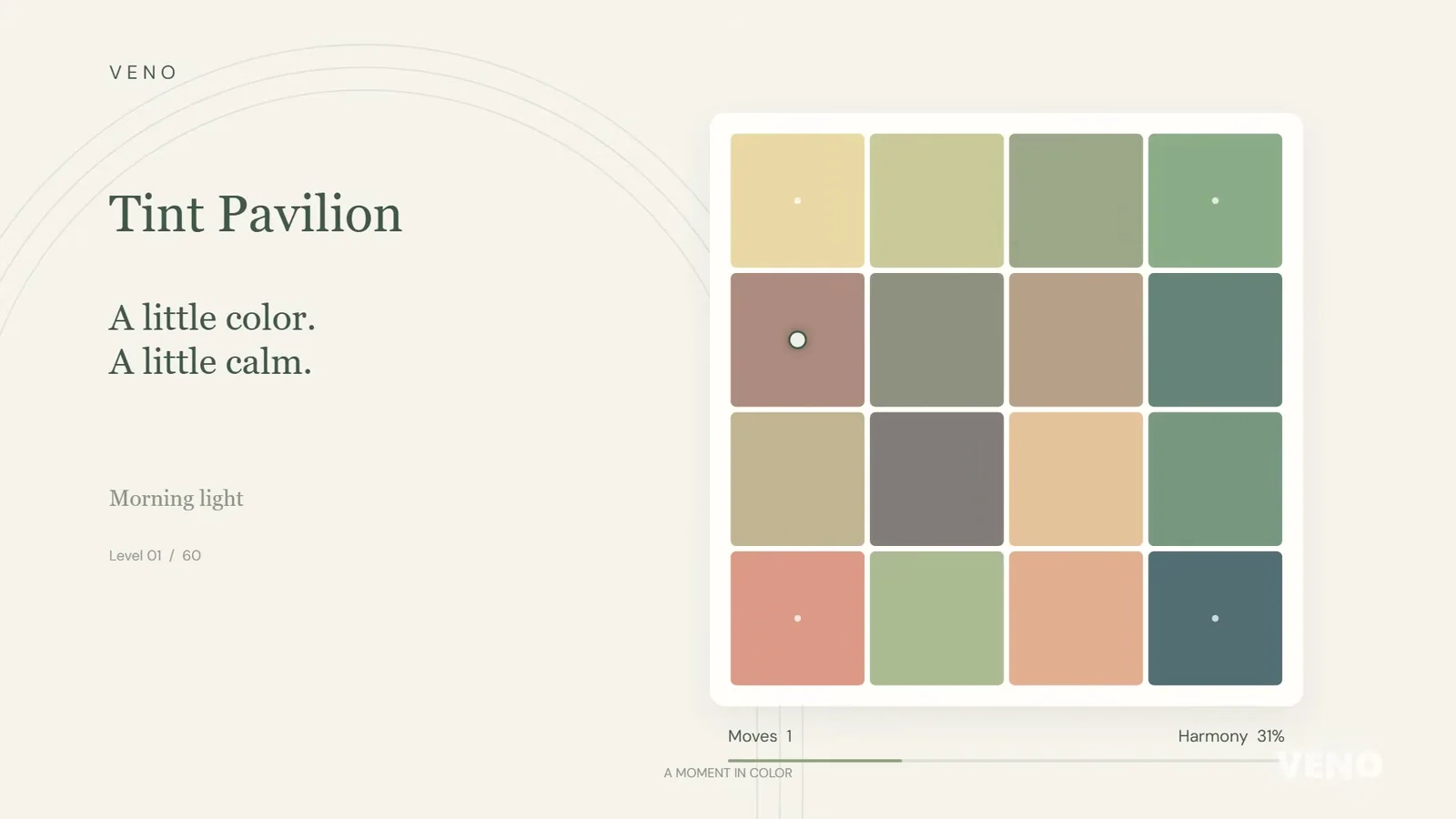
Most games in the genre share three rules:
- Some tiles are fixed. They are usually marked with a dot. They never move and act as anchors that tell you where the gradient starts and ends.
- You swap, you don’t slide. Pick two tiles and they trade places.
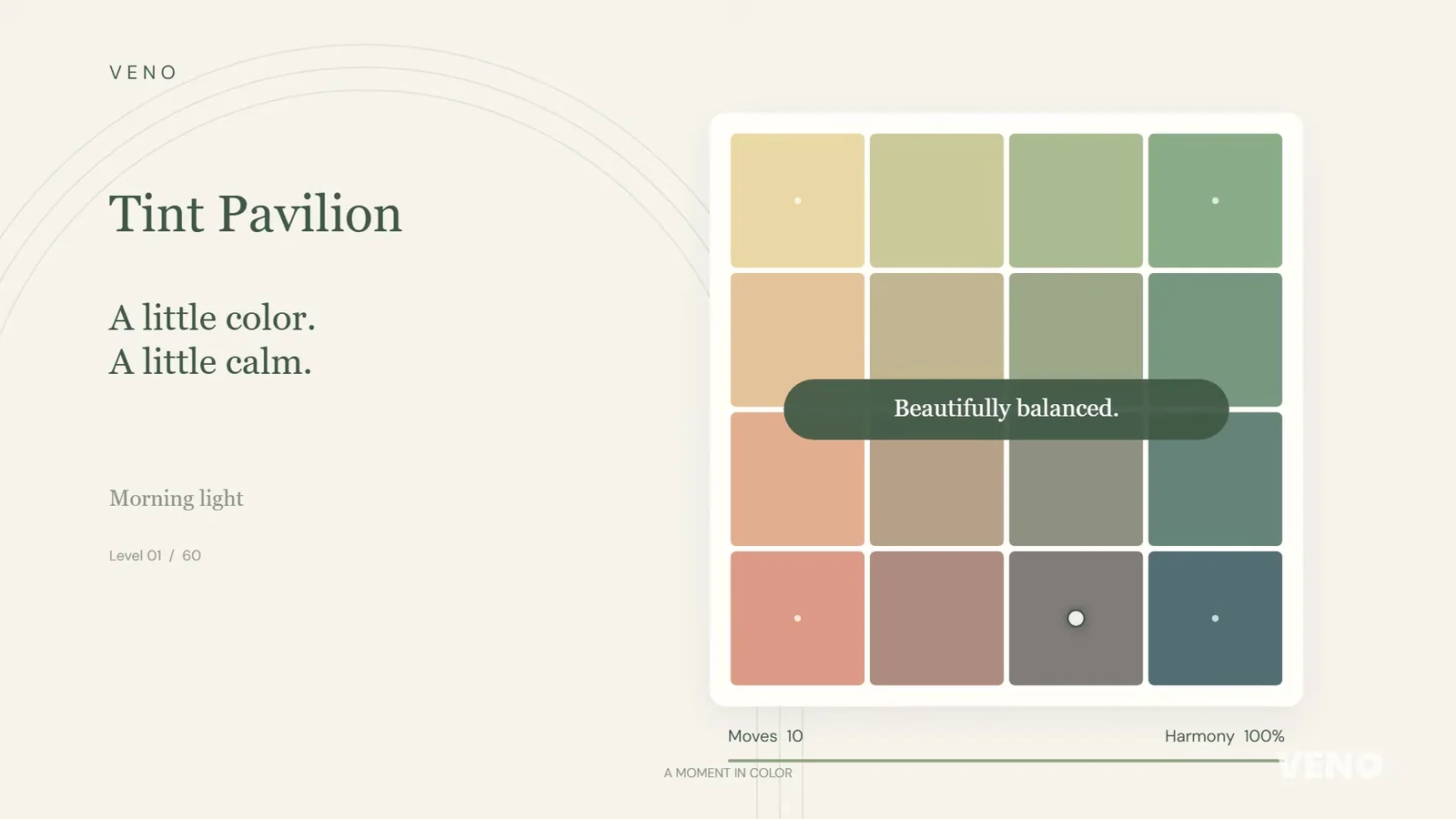
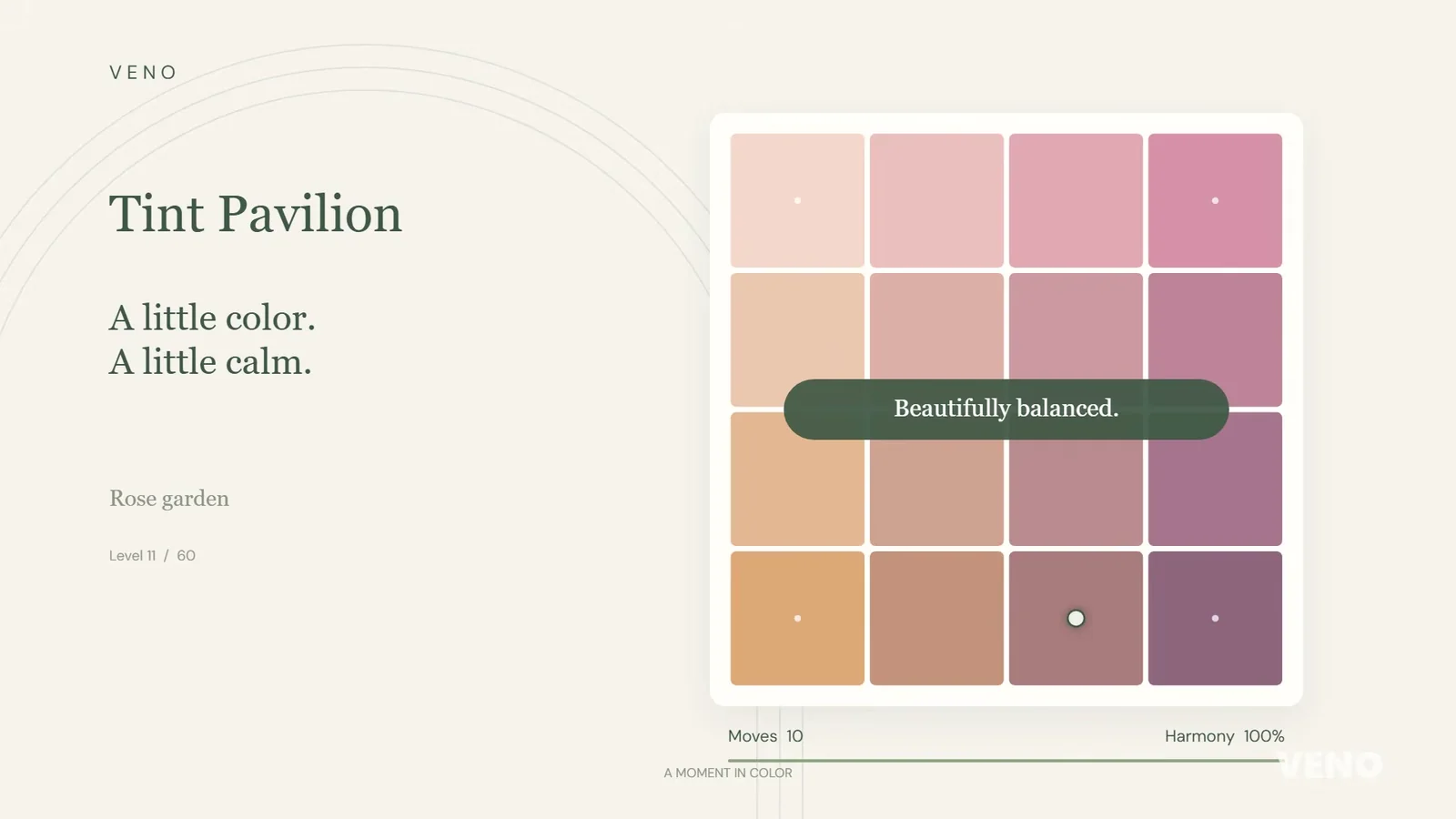
- The board checks itself. When every tile is in its place, the puzzle is solved. VENO Tint Pavilion shows this as a Harmony meter that climbs to 100%.
A short history: from eye test to phone game
The 100 Hue test
In the 1940s, the American scientist Dean Farnsworth designed a test for color discrimination. People were given rows of small colored caps and asked to arrange them in order of hue. Mistakes showed which parts of the color wheel a person found hard to tell apart. The Farnsworth–Munsell 100 Hue test is still used in fields where color matters, such as printing, textiles and design. Sorting colors by eye, it turns out, is both hard and strangely satisfying.
Blendoku and I Love Hue
Puzzle designers noticed the same thing. Blendoku (2013) asked players to place colored squares on a crossword-like grid so each line made a smooth blend. A few years later I Love Hue (2016) simplified the idea into a full rectangle of tiles with fixed dots, minimalist art and calm music. Its success inspired many games that share the same gentle rhythm: no timer, no enemies, just a slowly emerging gradient.
Today: calm games in the browser
Modern hue puzzles add palettes, daily challenges, hints and free undo. VENO Tint Pavilion follows this tradition with 60 levels across six palettes — Morning light, Rose garden, Still lagoon, Velvet dusk, Citrus grove and Moonlit iris — on boards that grow from 4×4 to 6×6, plus a Daily moment puzzle every day.
| Game | Year | Board | Typical pace |
|---|---|---|---|
| 100 Hue test | 1940s | Rows of color caps | A test, not a game |
| Blendoku | 2013 | Crossword-style lines | Puzzle by puzzle |
| I Love Hue | 2016 | Full grid with fixed dots | Calm, no timer |
| VENO Tint Pavilion | Today | 4×4 to 6×6 grid, dotted corners | Calm, no timer, free undo, browser |
How a gradient board is built
Every tile in a gradient puzzle is a mix of the colors around it. Along a row, the hue usually shifts in one direction (yellow toward green, for example). Down a column, it shifts in another (yellow toward coral). The tile in the middle of the board is therefore a blend of all four corners.
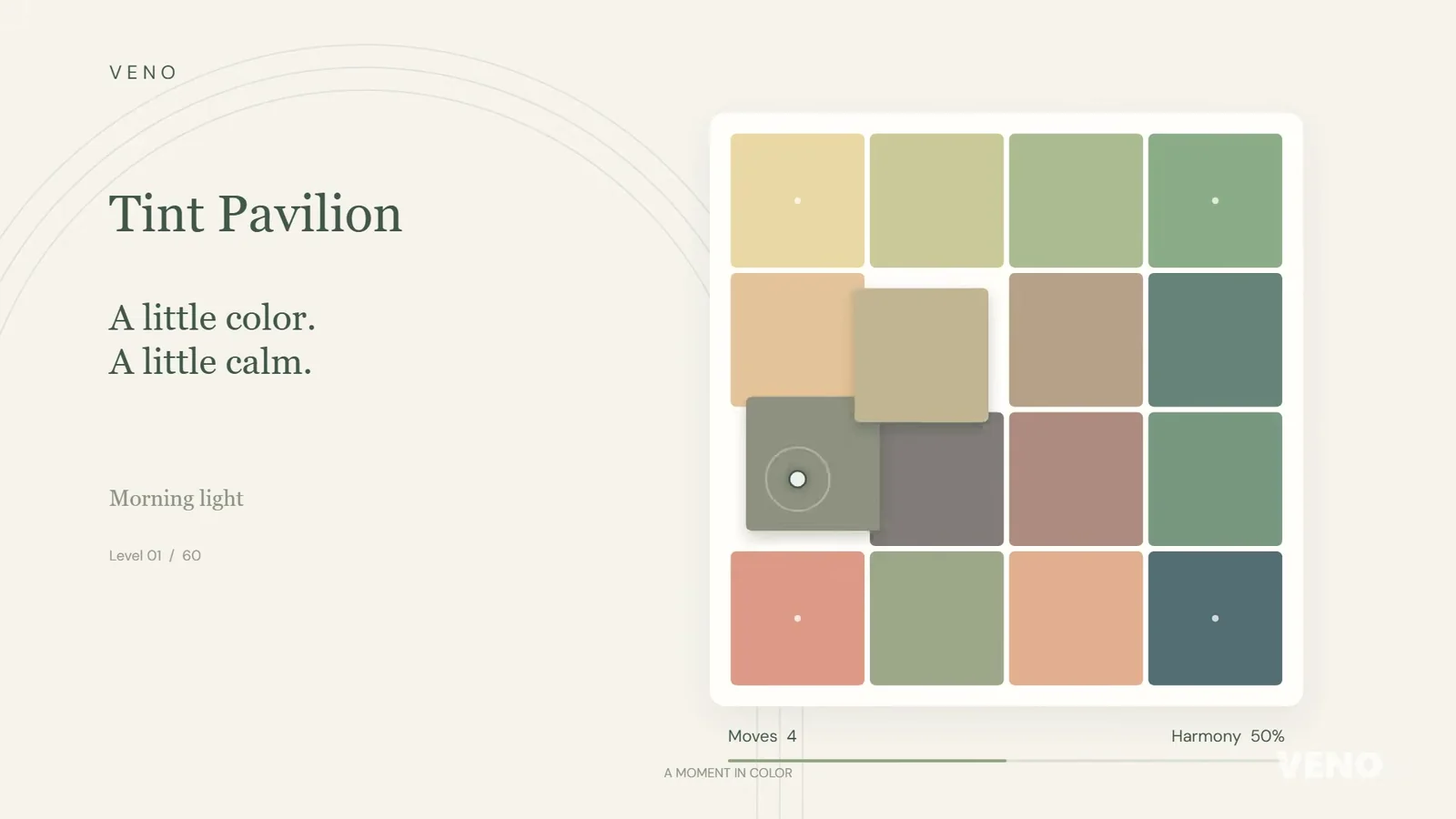
That gives you two clues for every spot: what its row neighbors are, and what its column neighbors are. Good players read both at the same time.
8 tips to reach 100% harmony faster
- Start from the dotted corners. They never move, so they are the only colors you can be sure about. Work outward from them.
- Build the edges first. An edge tile only blends between two anchors, so it is easier to judge than a center tile.
- Compare lightness before hue. Our eyes judge light and dark more reliably than small shifts in color. Sort a row from lightest to darkest first, then fine-tune.
- Look at pairs, not single tiles. Ask “which of these two is closer to the corner?” instead of “where does this tile go?”
- Watch the Harmony meter. In Tint Pavilion the percentage rises as more tiles find their place. If a swap makes it drop, undo it — undo is always free.
- Squint or step back. Seeing the board slightly blurred hides details and makes a tile that breaks the flow stand out.
- Use a hint only when truly stuck. A hint restores one pair, which is often enough to unlock the rest of a row.
- Leave the center for last. Once the four edges are right, the middle tiles have only one place where they look natural.
Why people love hue puzzles
Gradient puzzles are popular because they are quiet. There is no clock and nothing to lose, so you can play two minutes on a break or half an hour in the evening. They are also a pleasant way to practice noticing small differences in color, something many designers, photographers and painters enjoy. And the moment when a messy board turns into a smooth sweep of color is simply nice to look at.
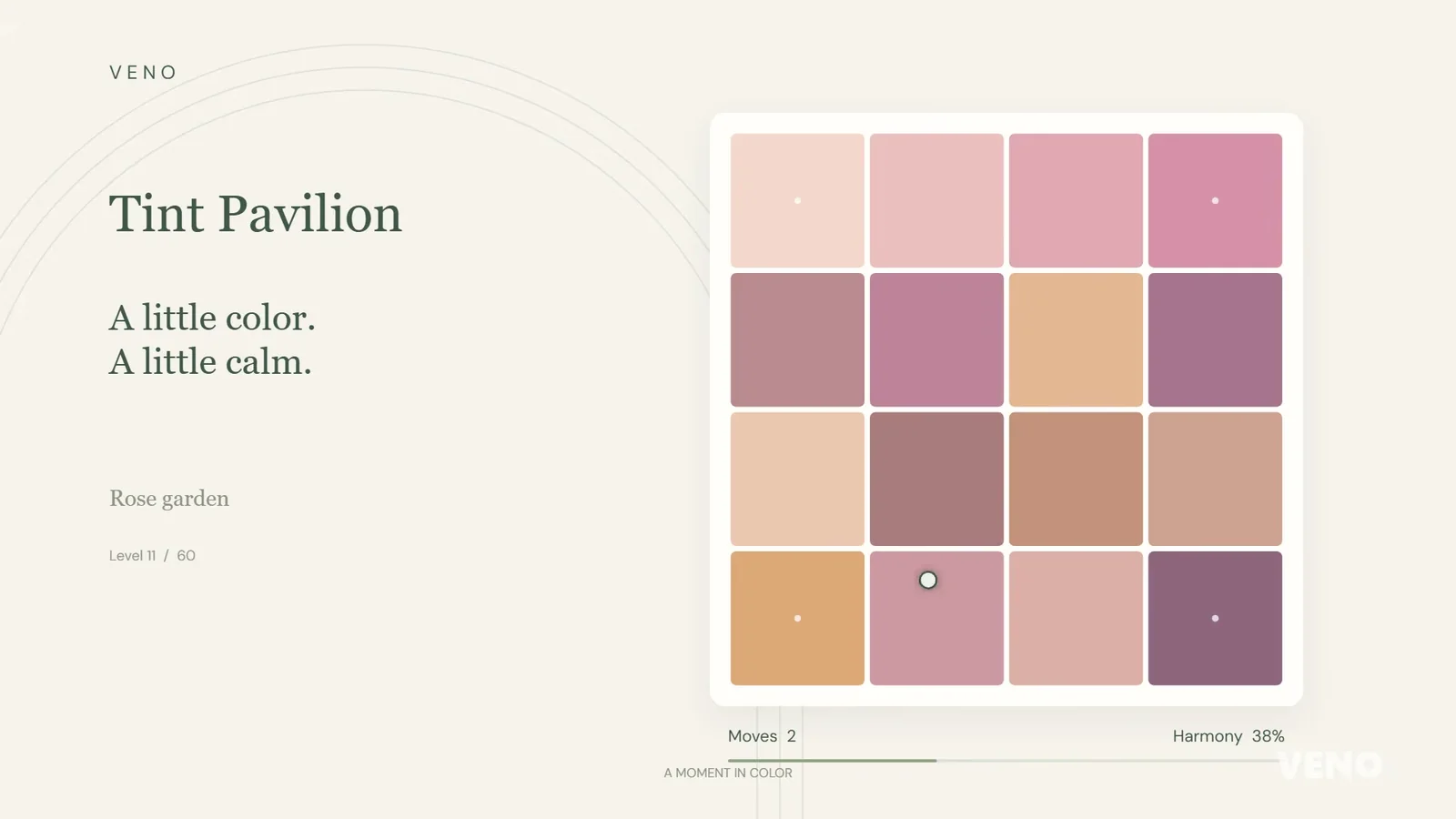
Each palette feels different, too. In VENO Tint Pavilion, Morning light uses warm yellows, greens and coral, while Rose garden moves through soft pinks, mauves and apricot, where the steps between tiles are closer and harder to spot.
Play it now
If you want to try a color gradient puzzle without installing anything, play VENO Tint Pavilion free in your browser. Tap two tiles or drag one onto another, use the dotted corners as anchors and watch the Harmony meter climb. It works on phone and desktop, supports the keyboard, and saves progress on your device.
FAQ
What is a color gradient puzzle?
It is a puzzle where shuffled tiles of similar colors must be swapped back into a smooth gradient. Fixed tiles, usually marked with a dot, show where the colors start and end.
Is there a game like I Love Hue that I can play in a browser?
Yes. VENO Tint Pavilion uses the same swap-the-tiles idea with fixed dotted corners, 60 levels across six palettes and no timer, and it runs free in the browser.
Are color gradient puzzles hard for color-blind players?
Some palettes can be harder, because certain hue steps look alike. Focusing on lightness (light to dark) helps, and calm games with free undo let you test swaps without penalty.
How do I solve the middle of the board?
Finish the four edges first. Each middle tile is a blend of its row and its column, so once the edges are right, there is usually only one spot where it looks natural.
Is there a time limit in VENO Tint Pavilion?
No. There is no timer, undo is always free and a hint can restore one pair when you get stuck.