
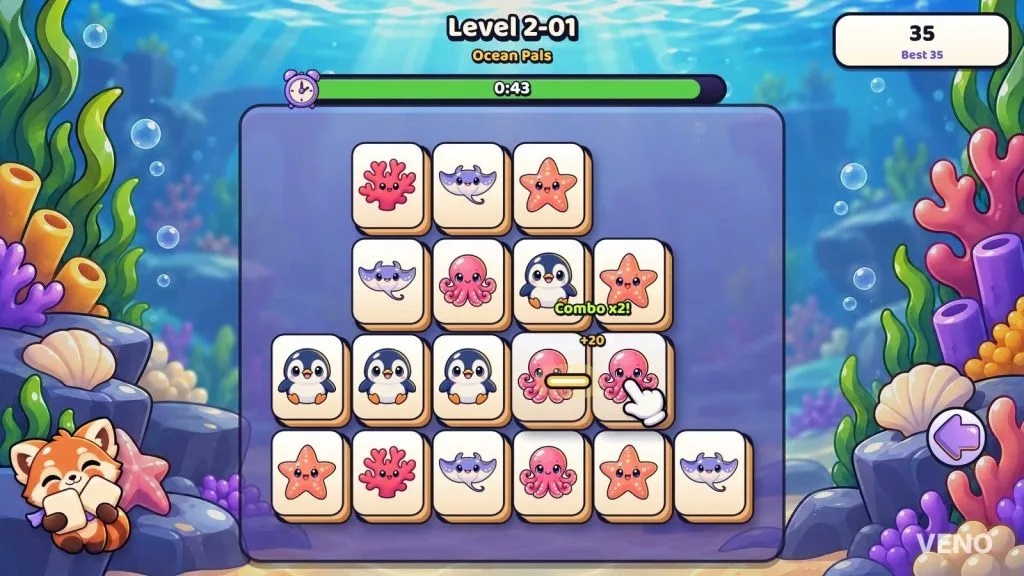
An onet connect game is a tile puzzle where you remove matching pairs by linking them with a line. The line may only run through empty spaces and may bend no more than two times. Clear every pair before the timer ends and you win the board. The rule fits in one sentence, yet it turns a simple picture match into a quick spatial puzzle.
▶️ Watch it in action: gameplay video · Shorts
| Quick facts | |
|---|---|
| Other names | Onet, Shisen-Sho, Mahjong Connect, Four Rivers, Lianliankan, Pair link |
| Goal | Remove every tile by linking identical pairs |
| Core rule | The link uses straight lines with at most 2 turns |
| Path limits | Only through empty cells; the outside edge counts as empty |
| Ancestor | Shisen-Sho, a mahjong tile game; Irem arcade version in 1989 |
| What it trains | Pattern spotting, planning ahead and calm speed |
How does an onet connect game work?
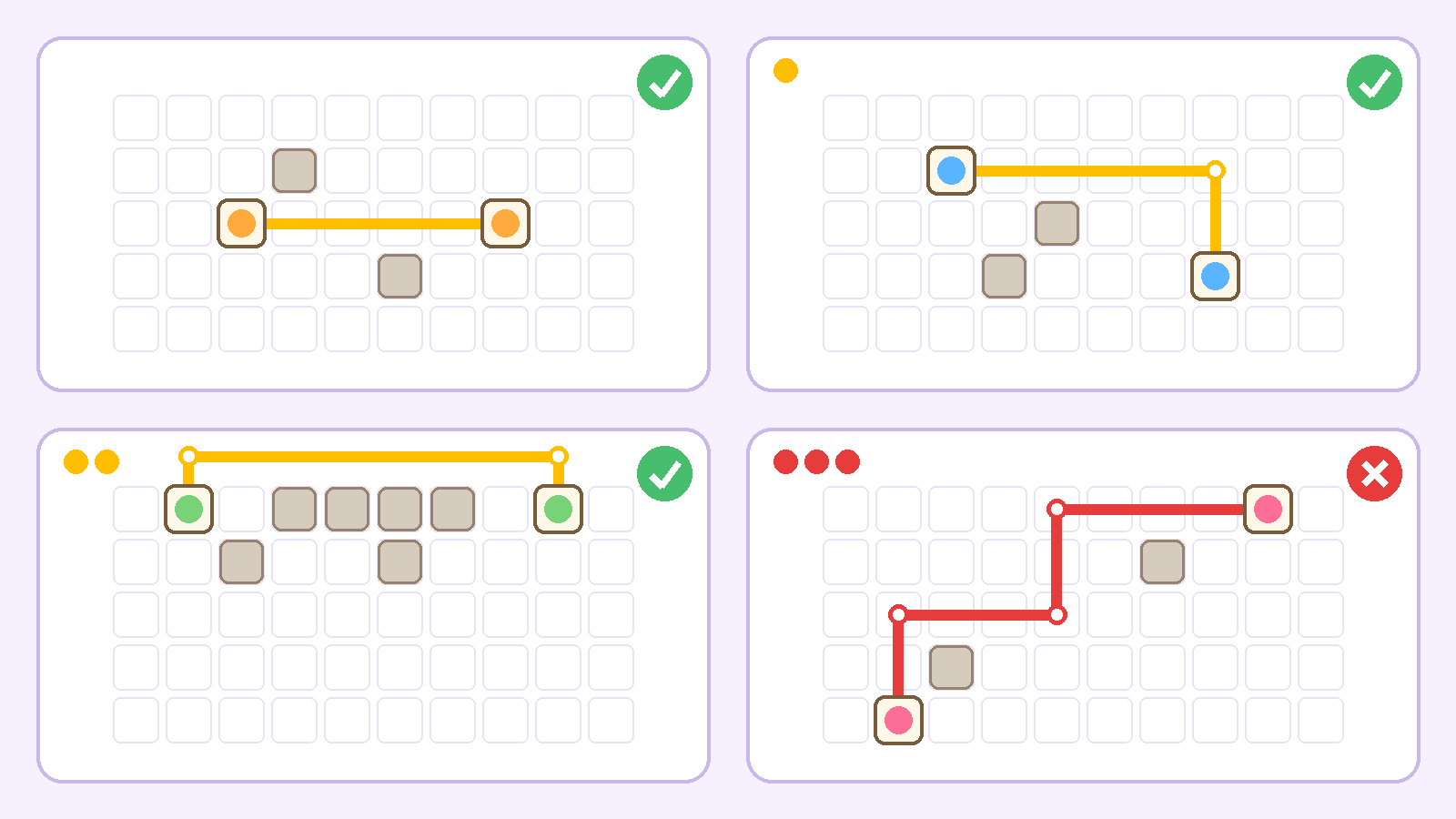
You tap one tile, then tap another tile with the same picture. The game checks whether a path made of straight horizontal and vertical lines can join them. That path must not cross any other tile, and it may change direction at most twice. If such a path exists, a line flashes and both tiles disappear. If not, nothing happens and you look again.
Players often name the legal paths after the letters they look like:
- I path (0 turns): the two tiles sit in the same row or column with only empty cells between them.
- L path (1 turn): one straight line, one corner, one more straight line.
- Z path (2 turns): the line steps sideways in the middle, like a staircase.
- U path (2 turns): the line goes out, runs parallel, then comes back. It often uses the empty border around the board.
A path with three turns is never allowed, even when it looks short. That single limit is what makes the genre interesting: the tiles you clear first decide which links open up later.
Where the game came from: Shisen-Sho and its many names
The ancestor of the onet connect game is Shisen-Sho (四川省, “Sichuan Province” in Japanese), a solitaire game played with mahjong tiles. Unlike classic mahjong solitaire, where tiles are stacked in layers and must be “free” on one side, Shisen-Sho lays every tile flat and asks you to connect pairs with a line of at most two turns.
The best-known early video game version is Shisenshō: Joshiryō-hen, an arcade game developed by Tamtex and released by Irem in 1989. Irem brought Shisen-Sho to Japanese home computers in 1990, and ports for MS-DOS, Amiga and Atari ST followed in the early 1990s. Later the rule spread to Linux and Windows collections (often as “Shisen” or “Four Rivers”) and, from 2005, to Flash games under the name Mahjong Connect.
Once the tiles stopped being mahjong tiles, the game travelled far and changed its name in every country:
| Region | What players call it |
|---|---|
| Japan | Shisen-Sho, also “nikakudori” (two-corner take) |
| China / Taiwan | 连连看 / 連連看 (lianliankan, “link-link-look”) |
| Korea | 사천성 (Sacheonseong, from Shisen-Sho) |
| Vietnam | Nối thú, often nicknamed “Pikachu” after old fan versions |
| Indonesia, Malaysia | Onet |
| English web portals | Mahjong Connect, Onet Connect, Pair Link |
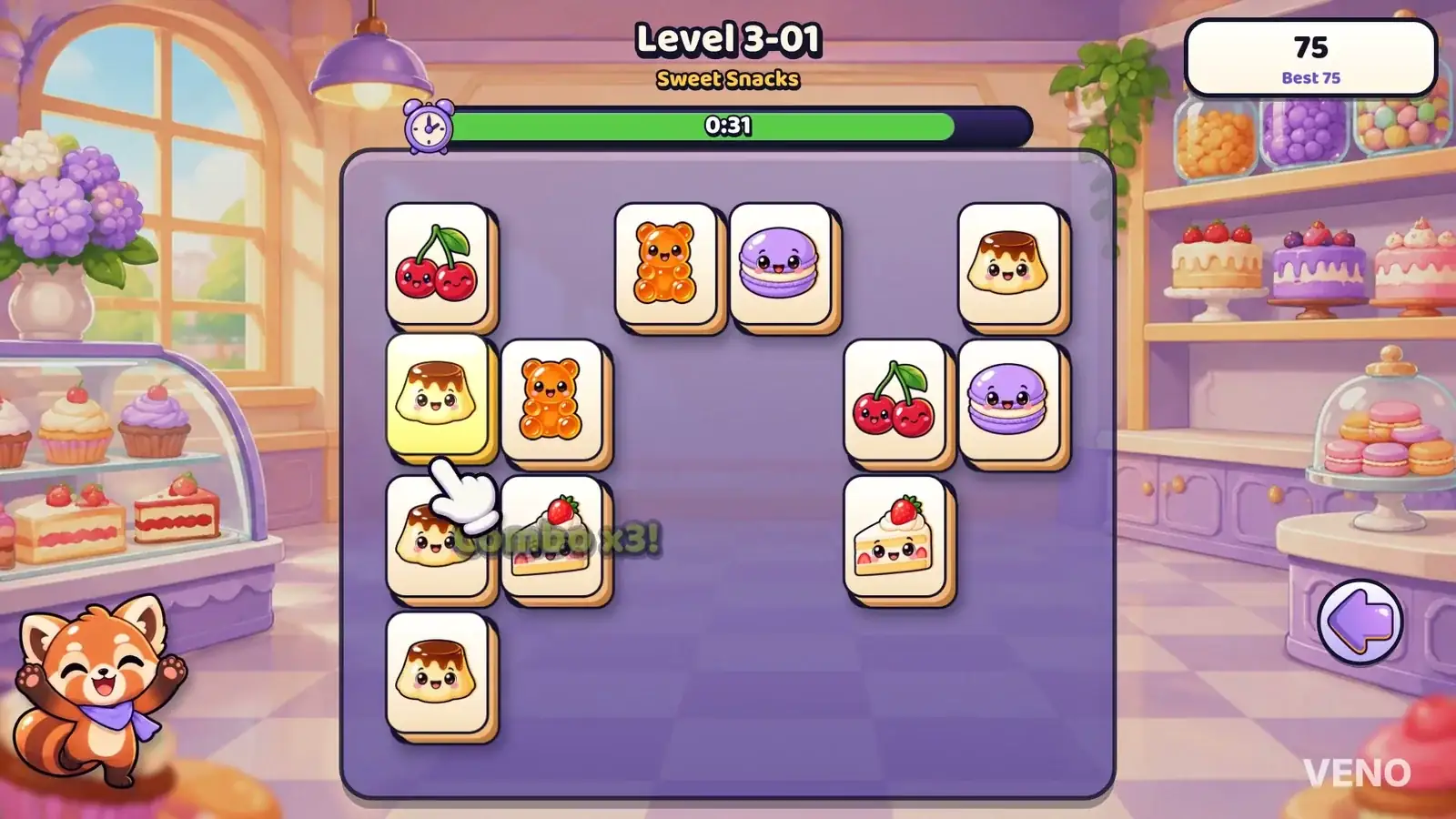
Animals, fruit and sweets replaced the bamboo and dragon tiles, and a countdown bar was added. That is the version most people picture today, and it is the version VENO Pairly is built on, with 108 original cute tiles instead of anyone else’s characters.
The scoring that makes speed matter
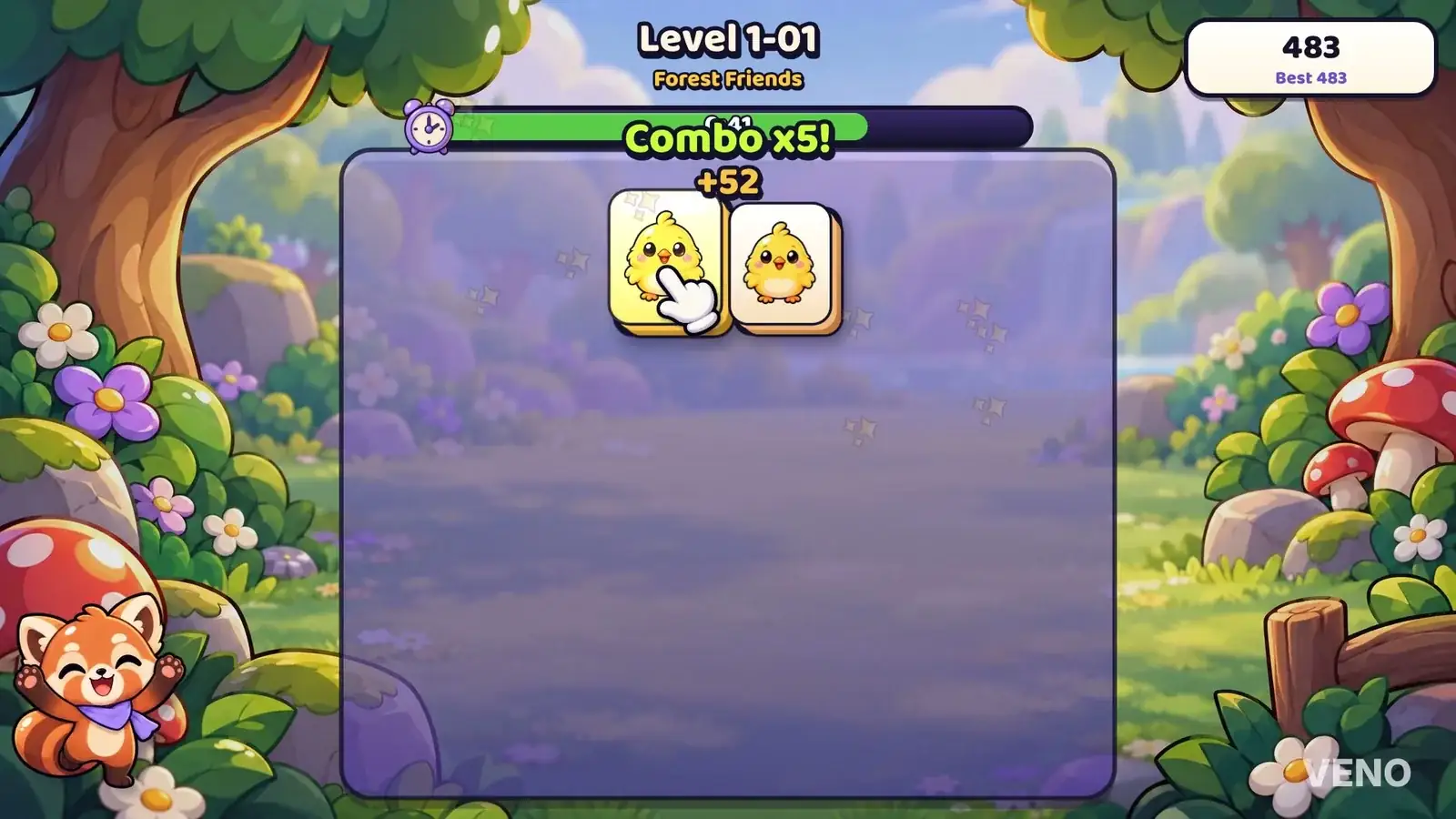
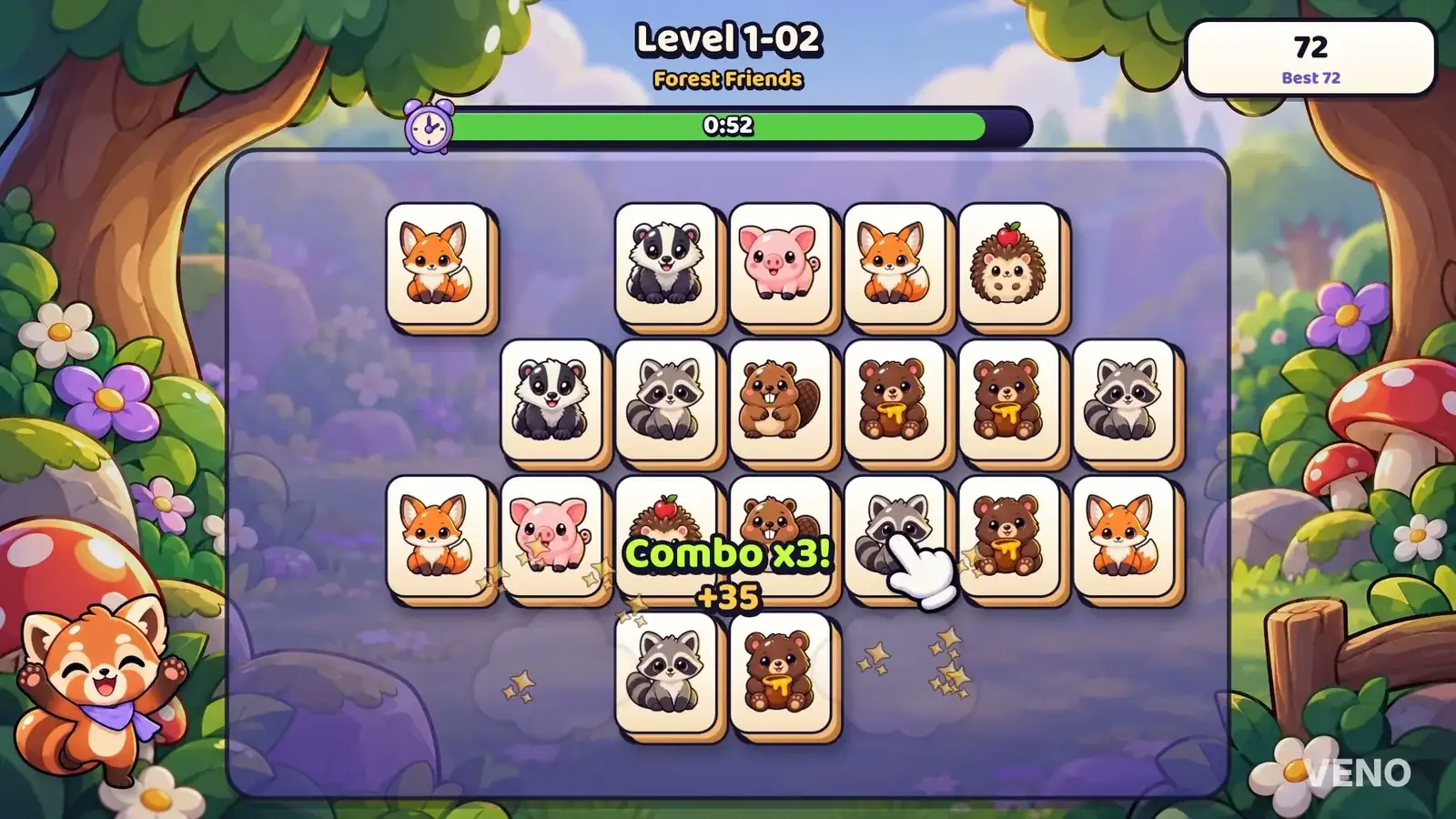
In a modern onet connect game you are racing a clock, so the score is built around pace. In VENO Pairly:
- Every pair is worth points.
- Linking the next pair within three seconds raises your combo, up to x5.
- Paths with one or two turns earn a small bonus, so long links are not a waste.
- When the board is clear, every second left becomes time bonus.
- You earn three stars by finishing with at least half the time left and no hint used.
Board types that change the puzzle
Classic Shisen-Sho boards never move. Newer connect games add twists, and VENO Pairly spreads them over 60 levels in four worlds:
| World | New idea | What it changes for you |
|---|---|---|
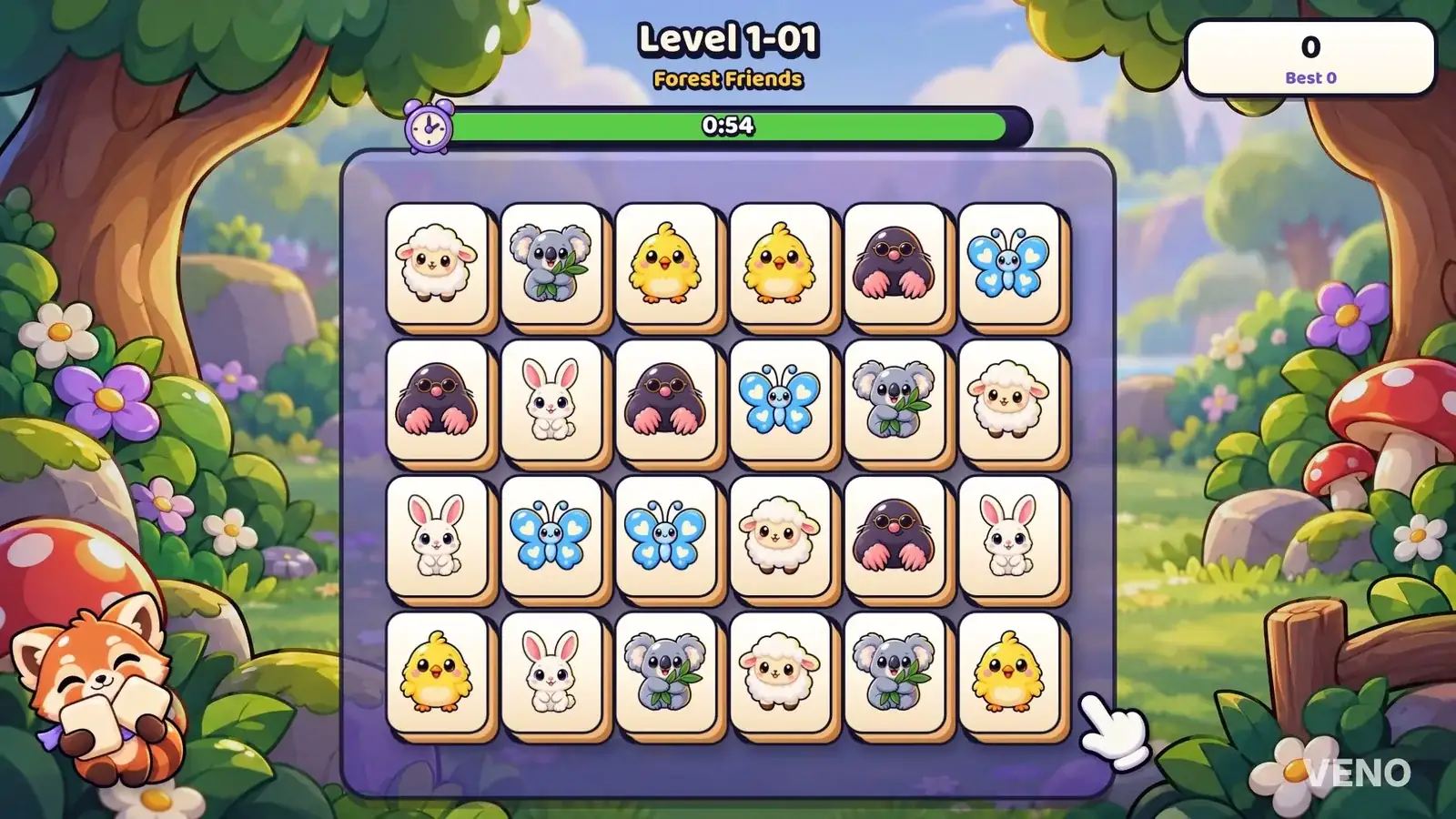
| Forest Friends | Holes and stepped shapes | Learn the I, L, Z and U paths |
| Ocean Pals | Gravity | After each pair, tiles slide down, up, left or right |
| Sweet Snacks | Wooden crates, boards that split apart | Crates block links; gaps open in the middle |
| Tiny Monsters | Tiles pulled to the centre, look-alike colours | Read pictures carefully before tapping |
Gravity boards are the biggest change. A pair you saw a second ago may slide away, while a blocked pair can suddenly line up. Watch where the tiles will move before you tap.
9 tips to clear every board
- Start at the edges. The empty border counts as path space, so outer tiles link easily with U paths.
- Clear blockers, not just easy pairs. Ask which tile is closing the most paths and remove its pair first.
- Count turns with your finger. Trace the line: straight, corner, straight, corner, straight. A third corner means it will not work.
- Look for long rows first. Wide empty rows and columns are highways for Z and U paths.
- Keep a pair in reserve for combos. When you see two easy pairs, link them back-to-back to keep the three-second combo alive.
- On gravity boards, think one move ahead. Before tapping, predict where the remaining tiles will slide.
- Spot the look-alikes. In later worlds similar colours appear; check the face or shape, not just the colour.
- Save hints for the end. A hint costs you the three-star chance, so try a shuffle or a careful scan first.
- Do not panic when stuck. If no pair can be linked at all, VENO Pairly shuffles for free, so a dead end never ends your run.

Play it now
Ready to test the two-turn rule? VENO Pairly is a free onet connect game that runs in any modern browser on phone, tablet or computer, in portrait or landscape, in ten languages, with nothing to install. You get three hints and three shuffles per level, and pausing hides the board and stops the clock.
FAQ
What is the rule in an onet connect game?
Tap two identical tiles. They disappear if a line of straight segments can join them through empty cells while turning no more than two times.
Can the line go outside the board?
In most versions, yes. The empty ring around the board counts as free space, which is why border tiles are often the easiest to clear.
Is onet the same as mahjong solitaire?
No. Mahjong solitaire stacks tiles in layers and you remove “free” tiles. Onet lays tiles flat and needs a path with at most two turns between the pair.
Where can I play an onet connect game for free?
You can play VENO Pairly free in your browser on phone or desktop, with 60 levels and no download.
Why is it called Pikachu or lianliankan?
The game has different names around the world. In China it is lianliankan (“link-link-look”), and in Vietnam many players still call it “Pikachu” after early fan-made versions with cartoon tiles.